In the competitive B2B market for mouse pads, understanding raw materials is crucial. Procurement managers and OEM brands demand the latest innovations in bases and fabrics. We break down the technical details – from rubber vs. foam bottoms to Lycra and high-thread-count cloth tops – with real examples (SteelSeries QcK, Razer Goliathus, ASUS ROG Scabbard) and up-to-date trends (2024–2026). The goal is to give private-label and Großhandel customers actionable insight into production-grade choices and capabilities.
Base Materials: Rubber vs. Polyurethane Foam
The base of a mouse pad can be natural rubber, synthetic rubber (like SBR), or a soft polyurethane (PU) foam. Each has trade-offs in grip, durability, and feel. Naturkautschuk bases (e.g. nitrile or latex) offer excellent elasticity and grip; however, synthetic rubber can cost less and resist heat and aging. High-end pads (like Zowie’s GTR series) are even using specialized rubber compounds engineered to mimic PORON foam’s softness while returning shape faster. In contrast, PU foam (like PORON) is an open-cell urethane prized for its plush softness and rebound. PORON pads (as in many SteelSeries, Razer, Logitech models) provide extra damping for precision, while modern rubber formulas are catching up on softness and rebound speed.
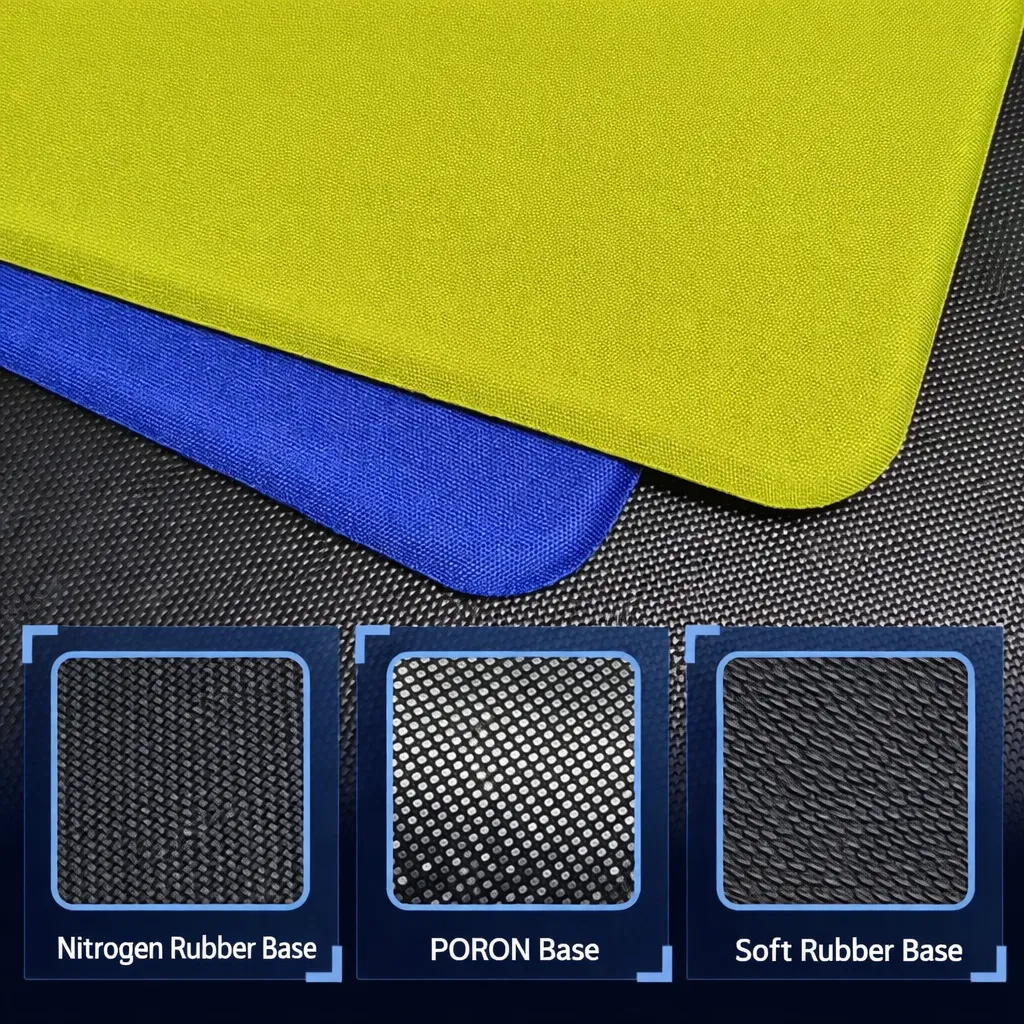
- Key Differences: Rubber bases (natural or SBR) tend to be more durable and grippy over time, whereas PU foam yields a softer feel with more initial resistance. Select based on desired rebound: rubber often snaps back quicker, while PU foam gives a more dampened response.
- Manufacturing: Factories mix and mold rubbers under heat and pressure. They can adjust hardness or tackiness via additives and vulcanization. PU foam sheets are cut or cast and laminated. Both bases can be die-cut or edge-sealed for volume factory-direct production.
Für bulk OEM orders, rubber (natural or synthetic) is common for its stability. Darshion’s production notes that natural rubber “offers excellent elasticity and wear resistance,” while synthetic rubber gives better aging resistance. Some manufacturers even apply glossy or matte polyurethane coatings on rubber bases to tailor friction and durability.
Surface Fabrics: Lycra, Micro-Woven and Woven Cloth
The top surface determines glide and feel. There are three main categories: high-thread-count micro-woven cloth (like SteelSeries QcK), patterned Lycra/spandex blends, and coarser woven textiles. Each suits different playstyles and branding:
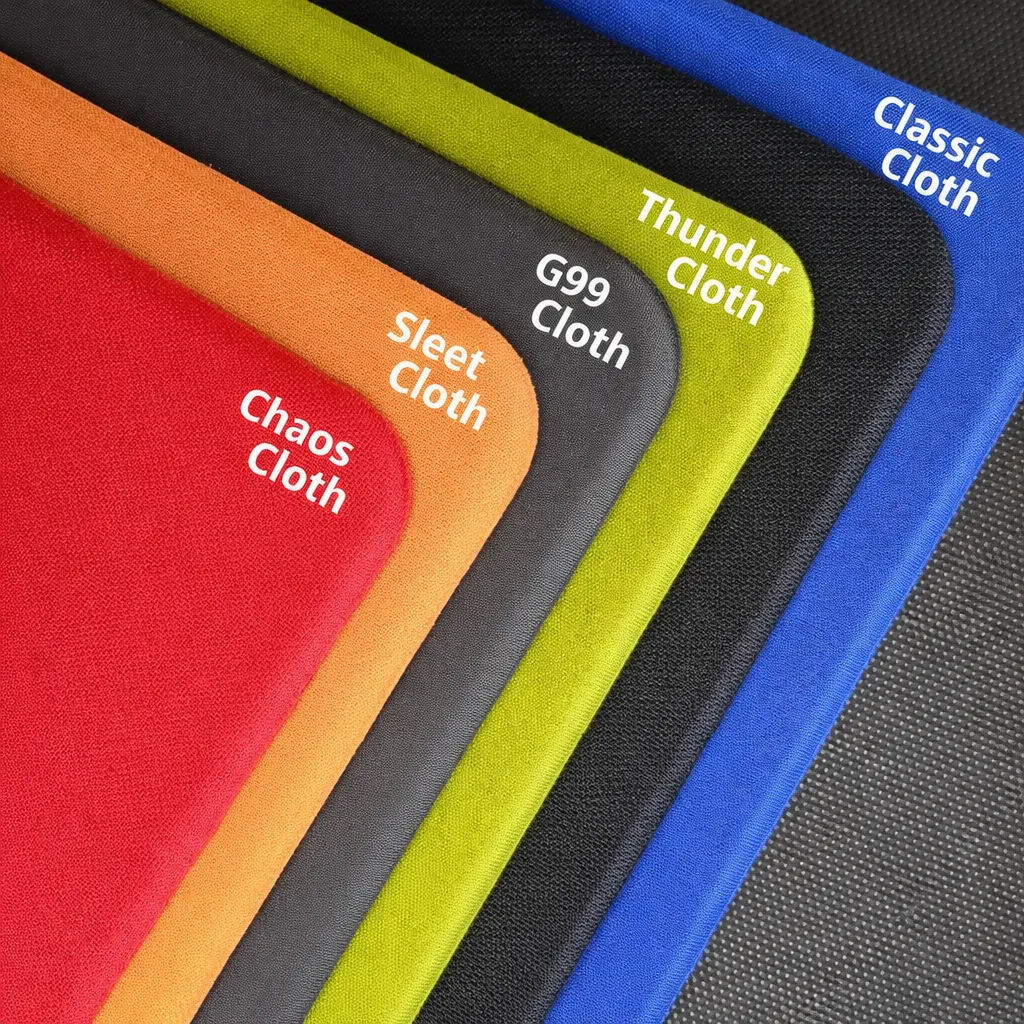
- Micro-woven (High Thread Count): Ultra-fine weaves (e.g. SteelSeries QcK) yield a very smooth, consistent tracking surface. These are often 2–4 mm thick (soft pad backed by dense rubber) and provide maximum precision for both laser and optical mice. They’re durable, washable, and easy to reproduce in volume. For instance, SteelSeries advertises their QcK micro-woven cloth “optimized for low and high CPI mouse tracking”.
- Lycra/Spandex Blends: Fabrics like Lycra (synthetic stretch knits) create very slick, elastic surfaces. They glide almost like hard pads but maintain a soft feel. Brands like Streberi or Xtrfy use sport textiles akin to Lycra for premium speed mats. These require flat-stitched edges and anti-fray coatings to stay durable. Currently, some factories offer custom Lycra cloth tops that are water-resistant and feature anti-fray hem stitching.
- Rough Woven/Textured Cloth: Thicker, coarse weaves (like those used in some “speed” pads or rugged office mats) increase friction slightly for control. For example, Razer calls its Goliathus a “micro-textured cloth surface” tuned for speed and precision, implying a textured weave under the smooth finish. Glorious and Fnatic pads also use unique weaves: some rough-knit cloths feel faster (lower friction) and can be coated for spill resistance.
Examples: X2’s XPAD Pro boasts a “glossy finish cloth texture” they claim improves mouse response. In practice, a glossy-coated weave can feel faster. Razer’s Goliathus Chroma uses a micro-textured cloth top with 3 mm rubber base. ASUS’s ROG Scabbard, in contrast, uses a woven Cordura® Lite nylon – a tough, water-resistant fabric – combined with a non-slip rubber base. The Scabbard’s coating makes it spill-proof and durable.
- Coatings & Finishes: Many cloth pads get special coatings. Glossy or “PU” laminations repel water/oil (making pads spill-proof). For instance, Logitech’s Studio Series pad uses a spill-resistant coated fabric so liquids wipe off easily. Others use matte finishes (like ASUS’s debut “Frostbite” coating) for a rougher texture that absorbs sweat. Anti-fray stitching around edges is now standard to prevent peeling on all types.
Product and Material Comparison
| Product / Material | Top Surface (Examples) | Base Material (Examples) | Key Features (2024–2026) |
|---|---|---|---|
| SteelSeries QcK (Cloth) | High-thread-count micro-woven cloth | Natural non-slip rubber | Soft control surface; ultra-durable; standard in esports; available as an OEM offering for Großaufträge |
| Razer Goliathus (Chroma) | Micro-textured polyester cloth | High-density rubber/foam (3 mm) | RGB-lit edge; tuned for speed and control; 3–3.5 mm thick; popular kit for individuelle Mauspads (private label RGB options) |
| ASUS ROG Scabbard | Cordura® Lite nylon (splash-proof woven fabric) | Red natural rubber (2 mm) | Water/oil resistant; very slim; anti-fray stitching; glow-in-the-dark accents; proven durable in pro gaming |
| Custom Cloth Pad (OEM) | Configurable: Lycra, PLA-treated cotton, etc. | Natural/SBR rubber or PU foam | Customized friction (glossy vs. matte); optional spill-proof laminate; flat or stitched edges; competitive factory-direct pricing on Großhandel volume |
Above, “Custom Cloth Pad” illustrates what a private-label buyer can specify. For example, Darshion can manufacture pads with matte or glossy PU coatings on any fabric, or even integrate special textures like carbon-fiber weave patterns for novel grip/feel. The table highlights how a Mauspad-Lieferant (like Darshion) matches or exceeds major-brand specs through in-house R&D.
Innovations in Mouse Pad Materials
Manufacturers constantly explore new materials:
- Carbon-Fiber Textures: Some gaming pads now have a carbon-fiber surface (or print) on a rubber base. These offer a hard, smooth glide like a glass pad but with more friction control. (AttackShark’s CM04 pad, for example, features a carbon-fiber top with a 2 mm anti-slip base.)
- Hard & Glass Surfaces: Beyond cloth, tempered glass tops are emerging. The ASUS ROG Moonstone Ace uses tempered glass for an “ultrasmooth surface” paired with a silicone base for grip. These give the fastest possible glide and uniform tracking, favored by high-sensitivity gamers.
- Coating Technologies: Alongside matte/glossy finishes, new nano-coatings make surfaces water- and oil-repellent. ROG Scabbard II pads use protective coatings with AATCC Level 100 repellency (for spill-proof performance). Logitech’s Studio Series similarly boasts a spill-proof PU coating, so sweat or coffee won’t compromise the weave. Factories can also laminate thin plastic layers (“spil-proof lamination”) onto cloth for easy cleaning.
- Embedded RGB and Electronics: RGB mouse pads (e.g. SteelSeries QcK Prism) use embedded LED zones under the fabric. Future R&D may even weave electroluminescent fibers into cloth. (Currently, typical OEM RGB pads place LEDs around the edge or a strip underneath a semi-transparent surface.) Wireless charging or sensors integrated into the pad are on the horizon for smart desktop mats.
- Customizable Thickness and Edges: OEMs can now offer variable thickness (2–5 mm or even dual-layer constructions) and low-profile (“desk mat”) designs. Anti-slip bases are also diversifying: along with classic rubber, we see gel inserts or patterned textures (hex grids, star dots) for extra grip.
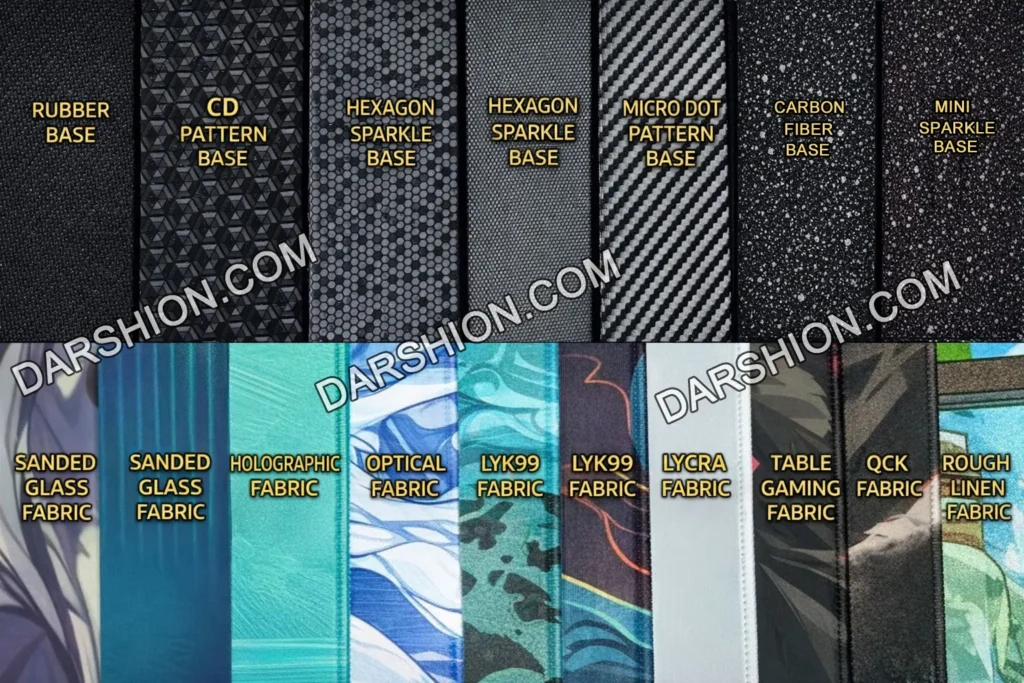
Through these innovations, factories help OEM clients hit exact design targets. For instance, a Großauftrag may specify a 2.5 mm PU-foam base for softness or a glossy-coated cloth with stitched edges for a premium look. B2B buyers can rely on production data: rubber hardness (Shore A rating), cloth weave density (threads per inch), and coating specs (e.g. % water repellency) are all measured during quality control.
From an OEM perspective, the takeaway is that material choices directly affect performance and cost. A bulk manufacture of mouse pads must balance grip vs. glide, durability vs. price. By comparing key brands and new materials (see table above) and leveraging factory expertise, procurement managers can specify the perfect pad for their customer’s needs.
Table: Key Materials & Products for OEM Mouse Pads
| Material/Feature | Vorteile | Considerations |
|---|---|---|
| Natural Rubber (NBR) | Excellent grip, durability | Some odor; slightly higher cost |
| Synthetic Rubber (SBR) | Cost-effective, heat-resistant | Less elastic over time |
| PU Foam (PORON®) | Plush feel, high rebound | Thinner pads; can compress under load |
| High-Thread Cloth | Smooth, precise control | Needs anti-fray edges |
| Lycra/Spandex Cloth | Ultra-fast glide, soft touch | Requires protective stitching |
| Cordura/Coated Nylon | Splash-proof, high durability | Usually thin (2 mm); more friction |
| Glass/Hard Top | Ultimate smoothness | Slippery if fingers moist; fragile |
| Spill-Proof Coating | Protects from liquids | Adds slight stiffness; multi-step apply |
| Embedded RGB | Visual appeal, branding | Adds cost; requires power and wiring |
(All values are examples; actual specs depend on factory settings and client requirements.)
Through careful material selection and testing, an OEM Mauspad-Lieferant can deliver custom pads that match or exceed the feel of branded products. The table above highlights how each material or feature impacts the final pad. For example, adding a spill-proof PU lamination makes a cloth pad easy to clean, while an RGB LED strip under a cloth layer adds premium flair. These are factory-controlled processes – from mixing rubber to precision weaving of cloth – ensuring quality and consistency.
In conclusion, we’ve shown how factory-direct production of mouse pads leverages advanced materials. Rubber and foam bases can be tuned (density, hardness) in-house. Cloth tops come in many high-tech variants (Lycra, coated weaves, etc.) as highlighted by top gaming pads. Recent pad releases emphasize features like water resistance and lighting, which modern OEMs can replicate. Private-label buyers should work closely with a knowledgeable Mauspad-Lieferant to choose materials by analyzing production data and real-world benchmarks. With the right factory partner, customized mouse pads with the latest rubber base technology and fabric finishes can be delivered in volume – satisfying competitive gamers and discerning users alike.