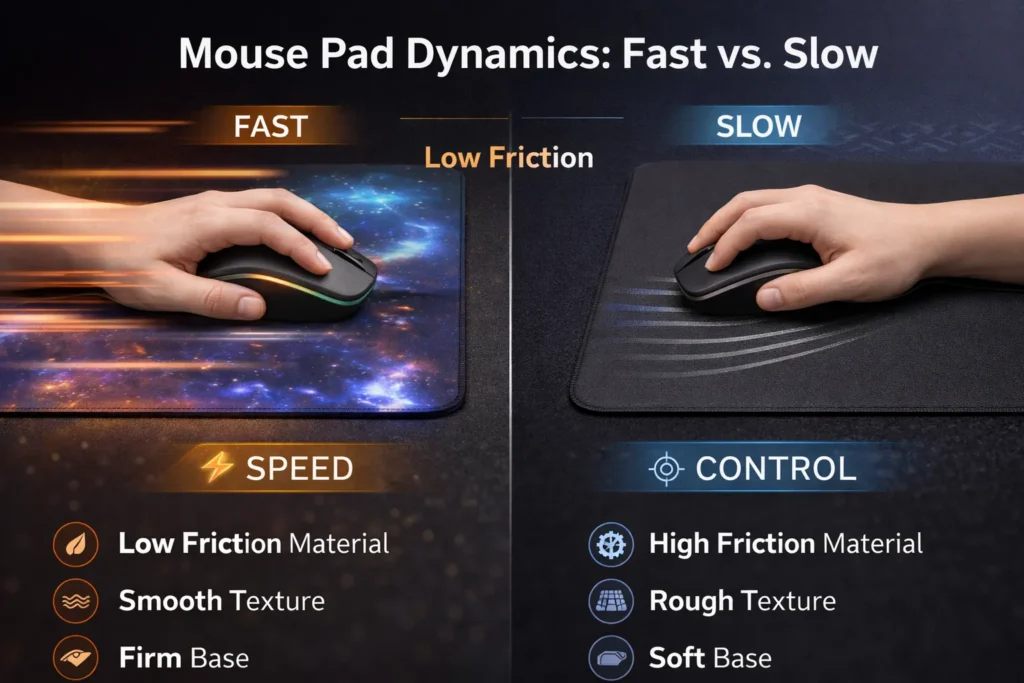
When you swipe your mouse and it glides effortlessly on one pad but drags on another, you’re feeling the subtle science of friction at work. “Fast” mouse pads have low friction, letting your mouse skate quickly, while “slow” pads create more resistance for tighter control. Understanding these differences is crucial for gamers chasing precision and for brands designing the perfect pad. Let’s break down the factors – from material and texture to base design – that determine why some mouse pads feel fast vs slow.
The Physics of Glide: Friction Basics
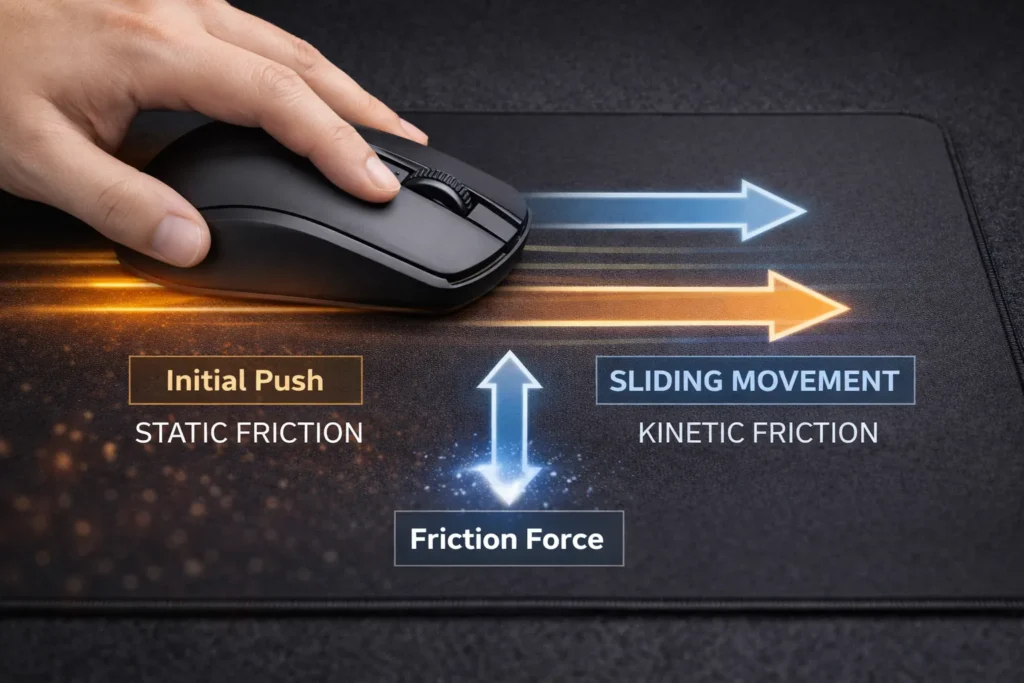
Before comparing materials, it helps to grasp why one mouse pad is faster than another. It comes down to friction – specifically static vs. kinetic friction. Static friction is the force needed to start moving the mouse from a standstill, whereas kinetic friction is the resistance while the mouse is sliding. A pad with high static friction might feel “sticky” at first (making micro-adjustments tricky), and one with high kinetic friction will slow your mouse as it moves (limiting top glide speed). An ideal “fast” pad has low static and low kinetic friction, so the mouse starts moving easily and keeps moving with minimal drag. A “slow” or control pad often intentionally increases kinetic friction – giving you more stopping power once the mouse is in motion.
Notably, different games favor different friction profiles. For example, in tactical FPS games (like CS:GO, Valorant), players often prefer some friction to help “lock” onto targets quickly after a flick. They want a bit more stopping power (higher kinetic friction) but still need low static friction for fine aiming adjustments. On the other hand, in fast-paced tracking games (like Apex Legends or Overwatch), a uniformly low friction pad is ideal for smooth, consistent crosshair movement. In other words, a speed pad with a slick glide helps track moving targets easily, whereas a control pad with a bit more drag can aid precise stops. The industry has even started tuning weave density and coating hardness of pads to match these needs for different genres – truly engineering surfaces for specific friction profiles.
Surface Materials and Textures: Cloth vs. Plastic vs. Glass
The material and texture of a mouse pad have the biggest impact on glide feel. Generally, hard materials yield faster glide, while softer fabrics add friction. According to Corsair, “hard mouse pads are almost always faster than soft mouse pads”, offering the lowest friction for quick movement. Soft cloth pads, by contrast, tend to have more friction, giving a slower, more controlled feel. But there’s a wide spectrum even among cloth pads, largely due to how they’re woven and finished.
To illustrate, here’s a comparison of common mouse pad surface materials, their typical glide characteristics, and ideal use cases:
| Surface Material / Texture | Glide Feel | Use Case | Notes |
|---|---|---|---|
| Smooth cloth (fine weave) | Fast, low friction – “speed” feel | High-speed gaming, FPS flick shots | Tightly woven polyester or microfiber provides a slick, quick glide. Minimal tactile feedback. |
| Rough cloth (textured weave) | Slower, higher friction – “control” feel | Precision aiming, low DPI play, office work | Coarser weave (e.g. Cordura nylon) adds drag for better control. More feedback for micro-adjustments. |
| Coated cloth surface | Initially very fast, smooth glide | Hybrid use – balance of speed & control | Special coatings (e.g. polycarbonate or water-resistant coating) reduce friction and block moisture. Glide remains quick and consistent, though some coatings wear over time. |
| Hard plastic | Very fast glide, minimal resistance | High-precision gaming, rapid strafing | Slick polymer surfaces allow effortless movement. Easy to clean, but can feel “slippery” and may produce noise. |
| Tempered glass | Extremely fast & smooth (nearly friction-free) | Ultra-low friction training, tech enthusiasts | Glass pads offer a silky glide and consistent texture. Incredibly durable, but can be loud and require getting used to almost no resistance. |
| Aluminum/Metal | Fast glide (with slight texture) | FPS gaming or design (limited use) | Hard metal pads stay smooth and cool; some have micro-texture for control. Can wear mouse feet quickly and tend to be smaller in size. |
| Hybrid (fabric + hard elements) | Balanced glide (moderate friction) | All-purpose gaming, mixed genres | Composite designs combine cloth feel with hardpad speed. Often aimed at providing both quick glide and reliable stopping power, depending on weave and coatings. |

As shown above, cloth pads vary widely. A smooth cloth pad (with a high thread count, tight weave) like a typical microfiber or polyester gaming mat will feel pretty fast – your mouse encounters less microscopic bumpiness, so it glides with ease. On the other hand, a rough-textured cloth pad (looser weave or tougher fibers like Cordura) creates more friction. The mouse feet ride over more bumps, slowing it down just a touch and giving a “grippier” feel. Interestingly, rougher doesn’t always mean slower in every way – some rough pads trap less surface area under the mouse feet (riding on the peaks of the texture) which can actually reduce static friction. But as a general rule, a coarse texture increases overall friction, making the pad feel slower/control-focused, while a smooth texture lowers friction for speed.
Hard pads (plastic, metal, glass) present an almost uniformly flat surface, so there’s very little friction holding your mouse back. A plastic pad or hard resin pad can make your mouse feel like it’s on ice. These are great for quick flick shots and rapid turns since there’s minimal resistance. The trade-offs: hard pads can wear down mouse skates faster and typically come in smaller sizes (since very large hard pads would be unwieldy or fragile to ship). They’re also less forgiving – there’s no “give” under the pad, so you lose that cushioned feel of cloth.
Glass pads take speed to the extreme. With specialized etched glass surfaces, the friction is ultra-low. In fact, one next-gen glass pad features a micro-etched texture and 9H hardness that yields a “silky” near-effortless glide. This can improve fast aiming, but it’s so slick that it often requires a couple weeks of adjustment for your muscle memory to handle the lack of resistance. Glass pads are niche (often used by enthusiasts to train with minimal friction), but they demonstrate how material alone can create a radically different speed feel.
Weave Density and Coatings: Fine-Tuning Glide and Consistency
Beyond base material, surface weave and coatings further fine-tune a pad’s glide characteristics. Manufacturers often experiment with the fabric’s weave density (threads per inch and how tight the knit is) and apply special coatings to achieve the desired fast or slow feel.
A tighter, higher-density weave generally produces a smoother surface (hence faster glide). For example, Darshion’s R&D has found that using ultra-high-density fiber cloth can give a “cushioned” yet controlled glide – in internal tests, a dense weave paired with a soft backing increased kinetic friction just enough to let the mouse stop almost instantly under force. That cushioned effect means when you press down, the pad “grabs” the mouse more. This principle is used in some high-end control pads: by weaving the fabric very tightly and pairing it with a thicker foam, the pad remains smooth to start moving, but offers more resistance when you push in – perfect for heavy-handed gamers who need that braking power.
In contrast, a low-density or slick-fiber weave (and thinner pad) won’t provide that brake. These are your classic speed pads, where the goal is pure glide. They might use textiles like satin-like polyester or even blended synthetic fibers that feel almost frictionless to the touch.
Coatings are another game-changer. Some mouse pads come with a polymer or resin coating on the surface. This can serve multiple purposes: reduce friction, increase consistency, and protect against moisture or dirt. A common example is a pad with a waterproof coating – not only does it make the pad spill-resistant, it also tends to feel more slippery. In fact, certain hybrid cloth pads add an iridescent or “speed” coating that makes the weave smoother and faster. Users often notice these pads are extremely fast out of the box (sometimes even too slick at first). There is usually a “break-in” period of a few days of use, after which the coating settles and the glide stabilizes to its intended level. So if you ever unpack a new pad that feels like an ice rink, don’t panic – it may be designed that way and will moderate with a bit of use.
One important benefit of certain coatings is consistency under different conditions. Traditional cloth is porous and hygroscopic (it absorbs moisture from the air and your skin). Thus, on a humid day a cloth pad can feel noticeably slower – the moisture makes fibers swell and increases friction. In fact, research shows high humidity (e.g. 80% RH) can increase a cloth pad’s friction by 15–25%, making your mouse movements feel heavier. This is why your aim might feel “off” in the summer versus a dry winter day. Coated or hybrid pads address this: a good water-repellent coating prevents moisture absorption. In lab tests, advanced coated surfaces only saw about a 5–10% change in glide at 80% humidity, versus drastic sluggishness on an uncoated cloth. In short, coatings keep the pad’s speed more stable by sealing the surface. This is a huge plus for pro players in varying climates – their mouse behavior remains consistent match to match.
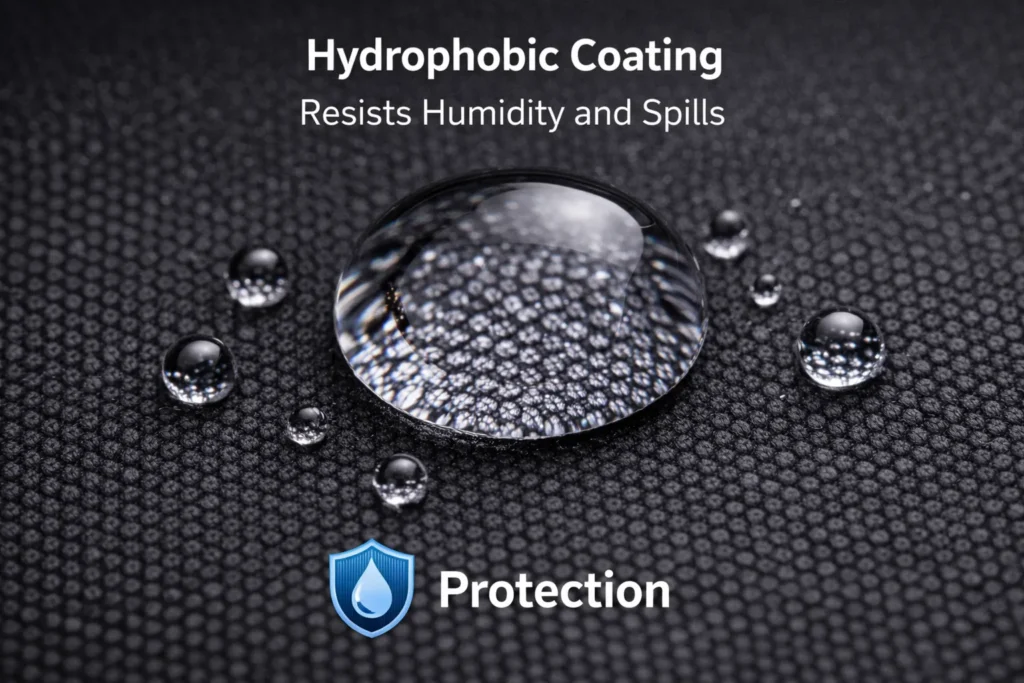
Of course, coatings can wear down over time. Many gamers have experienced a pad getting “slow” or developing rough spots after months of heavy use – often that’s the coating wearing off or the weave getting clogged with dust and oils. Regular cleaning (a damp microfiber wipe-down) can help maintain performance on coated pads. And higher-end pads use better quality coatings that last longer before you notice any change.
The Role of the Base: Thickness, Firmness, and Friction Control
So far we’ve looked at the top surface, but don’t overlook the mouse pad’s base (the rubber or foam layer underneath). The base gives the pad its thickness and firmness, which can subtly affect glide feel and control.
Most cloth gaming pads have a foam rubber base between 2–5 mm thick. A thicker, softer base provides more cushioning – when you press the mouse down, the base compresses. This effectively increases friction during that moment of pressure, acting like a brake. Players with a heavier hand often appreciate a bit of softness because as they push down in a flick or when stopping the mouse, that slight “sink” into the pad can help halt the motion. In fact, internal tests have shown that a 4mm soft rubber base paired with a dense cloth can let the mouse “stop almost instantly” under force. The pad literally conforms around the skates for a split second to increase drag. This is why many control-oriented pads are on the thicker side (3-4+ mm): the extra give provides a natural braking mechanism when needed.
By contrast, a thin or extra-firm base (some pads are even on a hard plastic backing) won’t compress much at all. The mouse stays on a level plane, and you get a very consistent, fast glide with no surprise increase in friction when pressing down. This is great for maintaining speed – preferred in speed pads or for high-sensitivity gamers who don’t want any squish. However, at extreme performance levels (like ultra-high DPI or 8000 Hz polling rate mice), a very soft base can introduce sensor inconsistencies. Even a 0.2 mm sink from a soft base can alter the mouse’s lift-off distance and tracking precision. For instance, competitive players using new 8000 Hz mice are often advised to stick with a firmer pad so the sensor isn’t moving relative to the surface during fast motions. In short, soft base = more comfort and stopping control; firm base = more consistent tracking and speed.
Manufacturers measure base firmness in terms of foam density or a Shore hardness rating. A mid-range firmness (not too hard, not too squishy) tends to give the best of both: a bit of give for comfort and control, but not so much that you get “muddy” movements or sensor jitter. Quality also matters – higher-end pads use closed-cell foam (which keeps its shape longer and doesn’t break down as quickly). Cheaper open-cell foam bases can start to lose firmness after months of heavy use, leading to uneven spots. Ever notice the edges of an old pad feeling different? Edges can sometimes be firmer if stitched, or the center softens with wear, altering glide across the pad. This is why pro players replace cloth pads fairly frequently; they need that like-new consistency.
In summary, the base under the surface can either act like a shock absorber or a stability platform. Thicker, softer bases (3–5 mm, foam rubber) absorb force, which increases control (at the cost of some speed), and they’re comfy for your wrist during long sessions. Thinner or harder bases (1–2 mm or hard backing) keep things fast and consistent but can feel harsh and offer less assistance in stopping the mouse. It comes down to user preference and use-case: an office user might love a cushioned feel, whereas a competitive gamer with steady hands might prefer the firm consistency.
Gaming vs. Office Use: Finding the Right Pad Speed
The ideal mouse pad speed isn’t universal – it depends on what you’re doing. Let’s compare needs for gaming versus office/general use:
- Gaming (Esports/FPS/MOBA): Gamers often categorize pads into “speed” vs “control” pads, and even a middle “balanced” category. For twitch shooters and high-precision aiming, the right glide can improve accuracy. As mentioned, a CS:GO or Valorant player on low sensitivity might lean toward a control pad that helps their aim stay steady (higher friction when moving fast, so they don’t overshoot targets). A MOBA or RTS player, doing rapid mouse movements across the screen, might want a faster glide to zip the cursor around. In competitive play, comfort is secondary to performance – a pad must be the correct friction profile for the game. Hard pads or smooth cloth pads are popular among high-sensitivity players and those who favor quick movement, because of the effortless glide. Meanwhile, many pros who play at low sensitivity choose thicker, slower cloth pads to give them maximum micro-control. There’s no one-size-fits-all – it’s about matching to play style. Interestingly, even X/Y axis differences can matter: some woven pads have slightly more friction on one axis due to the weave direction, which can affect tracking aim (this is something manufacturers like Darshion consider when selecting weave patterns for custom pads). The key takeaway for gaming is that glide speed directly impacts aim. That’s why gaming peripheral companies produce so many pad variants – each offers a different mix of speed vs. control to suit different gamer preferences.
- Office and Everyday Use: For general office work or casual use, extreme speed is usually not necessary. In fact, a very slippery pad can be a bit annoying for precise cursor placement in design work or clicking small UI elements. Office users tend to prefer comfort and control. A standard cloth pad is typically “just right” – it has medium friction that gives some tactile feedback and accuracy, and it’s easy on the wrist. Cloth pads are also quiet (you won’t hear scraping noises during normal mousing). Many office-oriented mouse pads even have wrist rests or use memory foam bases for extra ergonomics. The cloth surface shines in an office setting because it’s comfortable for long periods and offers enough friction to be precise, but not so much as to feel sluggish. According to one materials guide, cloth pads are recommended for “long time office or daily use” especially for users who need high comfort. They dampen vibrations and have a nice feel for everyday tasks. In contrast, a hard glass or metal pad in an office might feel too rigid or be too noisy as you work (and certainly overkill for spreadsheets!). So, for B2B buyers outfitting an office or for general consumers, a moderate-speed pad (often just a good quality cloth pad) is a safe bet. It provides a balanced glide that most people find natural and accurate for productivity.

In short, gamers should choose a pad based on their game genre and play style – faster pads for rapid aiming and tracking, or slower pads for precision and control. Office users typically prioritize comfort and control, often sticking with cloth surfaces. The good news is that by understanding materials and design, you can pick (or customize) the right pad for any scenario.
Tailoring Mouse Pads for Specific Glide Profiles
By now it’s clear that glide speed is determined by a mix of material, texture, coating, and base. What if you’re a brand or team that wants to create the perfect pad for your needs? This is where working with a manufacturer like Darshion really makes a difference. As a leading mouse pad manufacturer with years of experience, Darshion understands these nuances and can tweak each variable to dial in the exact friction profile you desire.
For example, say an esports team wants a pad for competitive FPS. They might request a slightly rough, high-density weave cloth to get that control feel, a 4mm rubber base for added stopping power, and a mild water-resistant coating to ensure humidity doesn’t throw off the glide. Darshion can produce a custom mouse pad design to those specs – testing different fabrics and foam until the glide and feel are just right. On the flip side, a company looking to order wholesale gaming mouse pads for a broader audience might ask for a balanced pad: medium-fast glide that appeals to most gamers, with a durable surface that lasts. Through material selection and prototyping, we ensure the bulk order meets the target performance.
Even corporate and office clients can benefit from customization. Need an ultra-comfortable office pad for an entire organization? We can adjust the base thickness (e.g. use a plush memory foam layer) and choose a cloth texture that’s easy to control and emblazon it with your company’s logo through high-quality printing. When you work with Darshion on a bulk mouse pad project, we consider the end-user’s needs – whether it’s lightning-fast swipes or steady, ergonomic pointing.
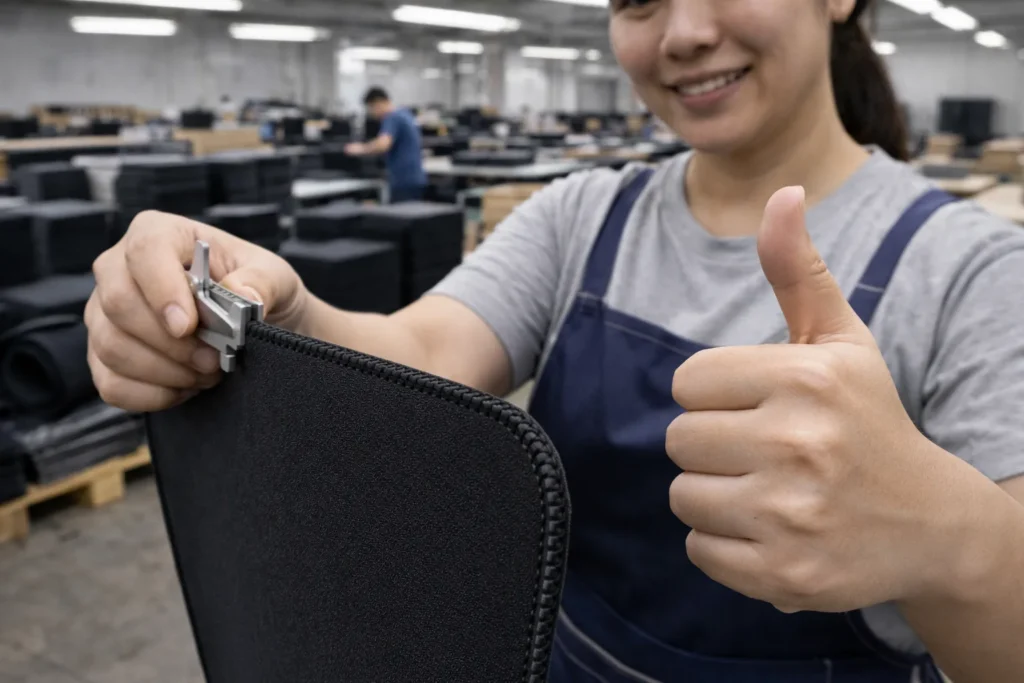
Crucially, we test our pads. Darshion’s development process involves measuring static and kinetic friction on prototypes (using weighted sled tests and high-speed cameras) to ensure consistency across the surface. We also perform environmental tests (so a batch of pads won’t all turn slow in high humidity, for instance). we engineer solutions for your specific needs grounded in real data and manufacturing knowledge.
Conclusion
Different mouse pads feel fast or slow due to the interplay of physics and design: the material (cloth vs hard), surface texture, coatings, and base all contribute to friction levels and glide behavior. Gamers can use this knowledge to choose a pad that complements their aim, and B2B buyers can make informed decisions when sourcing bulk mouse pad orders for various user groups. If you’re looking for a partner to create your ideal pad – whether it’s a pro-grade wholesale gaming mouse pads order or a unique custom mouse pad design for your brand – Darshion is here to help. We specialize in tailoring surface speed and control to your requirements, ensuring you get a product that not only feels right but gives you a competitive edge.
Ready to craft a mouse pad that’s “just right”? Explore our offerings and get in touch with Darshion today. Check out our gaming mouse pad catalog or learn more about our manufacturing services to start your journey toward the perfect glide. Your ideal mouse pad – whether lightning-fast or meticulously controlled – is within reach, and we’ll manufacture it to perfection. Happy gliding!