When a buyer searches this topic, the intent is usually not curiosity alone. In most cases, they are trying to answer a commercial question: why are more companies moving away from generic off-the-shelf keyboards, and is a custom keyboard strategy now worth the investment? For sourcing managers, brand owners, and product teams, the real concern is practical: will customization improve margin, user experience, or workflow efficiency enough to justify tooling, design, and procurement complexity?
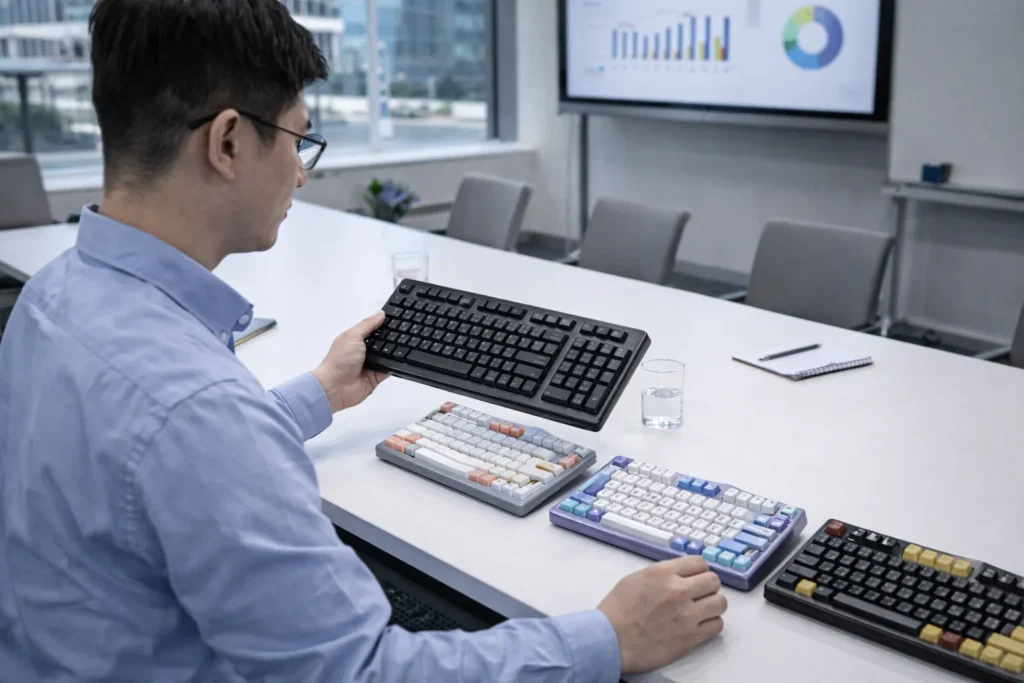
From a factory point of view, the answer is increasingly yes. The keyboard category is no longer driven only by consumer retail. The broader keyboard market is still growing, with Technavio estimating a 5.79% CAGR from 2023 to 2028, and noting that the corporate segment held the largest revenue share in 2022. At the same time, Grand View Research estimated the gaming keyboard market at USD 1.105 billion in 2024, with continued growth through 2030, while the mechanical gaming segment alone generated USD 740.5 million in 2024. That matters to B2B buyers because mechanical, programmable, and layout-specific features are no longer “enthusiast extras”; they are becoming standard commercial requirements across multiple sectors.
What Is Driving This Shift From a Factory Perspective?
Factories see the change before the market reports explain it. Five years ago, most custom keyboard inquiries were still small, design-led, or heavily gaming-oriented. In 2026, inquiries are broader and more structured. Buyers are asking for custom layouts, branded housings, multilingual legends, integrated modules, and workflow-specific macros. They are also asking for lower MOQs, faster sampling, and modular tooling approaches that reduce risk in first-order projects.
This shift is not random. It is being pulled by real business use cases. Corporate buyers want ergonomic and wellness-oriented keyboards for office and hybrid workforces. POS and industrial buyers want programmable layouts, integrated readers, and durable housings. Brand owners want private label products that are not identical to what every competitor is sourcing from the same catalog. Promotional and channel buyers want premium branded peripherals with more staying power than low-value giveaways. Grand View Research’s promotional products procurement analysis also points to continued growth in customizable branded products, forecasting a 3.75% CAGR from 2024 to 2030.
1. Private Label Differentiation Is Becoming More Important
One of the biggest reasons custom keyboards are growing in B2B markets is simple: generic keyboards are no longer enough for brands that want defendable positioning. In highly competitive channels, especially online, product sameness destroys margin. If ten sellers offer nearly identical keyboards with the same mold, switch type, and default layout, price becomes the only lever. That is not a sustainable place to be.
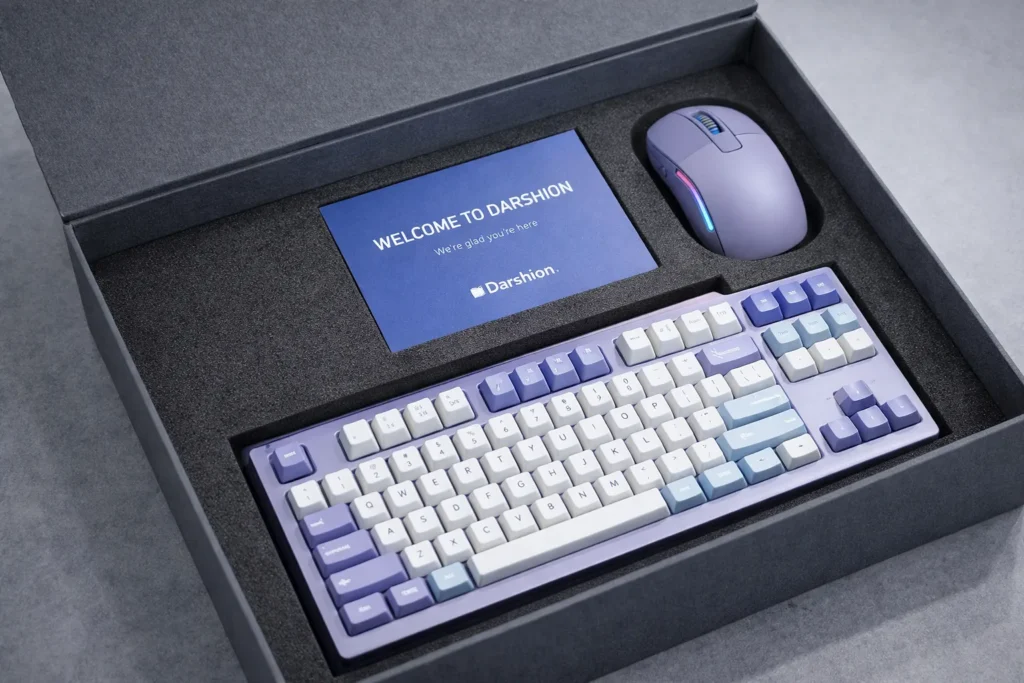
From the factory side, this is where OEM and ODM demand has become more strategic. Buyers are no longer just asking for logo printing. They are asking for case color matching, regional legends, switch tuning, plate materials, packaging design, and software-level differentiation. In practice, even moderate customization can create stronger channel separation. A branded 75% keyboard with tuned acoustics, custom legends, and business-specific shortcuts is far harder to compare directly against a generic catalog model. This is why many B2B buyers now see custom keyboards not as an accessory project, but as a margin protection tool.
2. B2B Buyers Need Workflow-Specific Input Devices
A second growth driver is function, not branding. In many B2B environments, the standard keyboard layout is not the most efficient one. Retail, logistics, healthcare, manufacturing, control rooms, KVM applications, and secure facilities often need custom key maps, dedicated macro keys, integrated readers, or unusual form factors. This is where programmable and modular keyboards are expanding fastest.
This is not just theory. PrehKeyTec publicly markets fully configurable programmable keyboards where customers can define key size, arrangement, lettering, color, and integrate modules such as RFID or fingerprint readers. IHSE’s programmable keyboard line similarly supports customer-specific key printing, additional keypads, and safety-critical deployments, while also advertising durability up to 50 million keystrokes. These are strong signals that the market is not just asking for aesthetic variation. It is asking for purpose-built hardware that improves speed, reduces input errors, and adapts to operational software.
From the manufacturing side, this kind of demand is especially attractive because it moves the conversation away from pure price comparison. Once a keyboard becomes workflow-specific, buyers evaluate it against productivity, process fit, and error reduction. That changes the economics. A custom keyboard that helps a medical receptionist, warehouse picker, or cash handler save seconds on repeated tasks can generate more value than a cheaper generic keyboard ever could.
3. Ergonomics Is Now a Budget Line, Not a Nice-to-Have
Ergonomics is another major reason custom keyboards are growing in B2B markets. For years, ergonomic keyboards were treated as specialty products for a small percentage of users. In 2026, more employers see them as part of workplace health, retention, and productivity strategy. From a factory point of view, we now see more RFQs that specifically request split layouts, low-force switches, compact formats, negative tilt compatibility, or wrist-position improvements.
The commercial logic is strong. Logitech’s ergonomics white paper cites that 15% of U.S. computer users experience daily pain in the hand, wrist, forearm, or shoulder, and states that office workers with wrist pain alone typically experience a 15% productivity loss. The same paper also notes that direct costs of repetitive motion workplace injuries in the U.S. reach USD 1.5 billion, while approximately four in ten Americans say pain interferes with work or daily life. For employers procuring equipment at scale, that makes ergonomic keyboard selection a financial issue, not just a comfort issue.
This is exactly why factories are seeing more requests for customized ergonomic products rather than fully generic ones. Different workforce groups do not always want the same thing. Some need split keyboards. Some need lower-profile layouts for laptop-heavy workflows. Some need left-handed numpads or programmable layers to reduce repeated reaches. A factory that can build from a modular platform can now respond to those needs with lower tooling risk than in the past.
4. Mechanical and Premium Segments Are Pulling B2B Upward
Another reason custom keyboards are growing is that premium keyboard expectations are rising everywhere, not just in gaming. The mechanical segment is growing because users increasingly expect better feel, longer lifespan, easier serviceability, and more control over typing performance. Grand View Research reported that the mechanical gaming keyboard segment generated USD 740.5 million in 2024 and is expected to exceed USD 1.25 billion by 2030. Even for non-gaming buyers, that trend matters because it normalizes higher-spec hardware in the market.
From a production standpoint, mechanical platforms are easier to customize than many buyers assume. Once the PCB architecture and plate system are stable, factories can alter switch type, plate material, keycap profile, lighting logic, and outer case details without redesigning the entire product. That makes custom mechanical keyboards especially attractive for B2B brands that want differentiation without starting from a blank sheet. In many cases, the factory is not creating a completely new product. It is configuring a proven platform into a commercially distinct SKU.
This shift is especially visible in channel brands and specialist resellers. A custom keyboard can now combine enthusiast-grade features with business requirements: multilingual legends, regional firmware, custom macros, or private packaging. That is one reason custom keyboards are moving from “hobby category” into serious B2B procurement.
5. Lower MOQ and Faster ODM Cycles Have Changed the Economics
In the past, many B2B buyers avoided custom keyboards because tooling, sampling, and MOQ requirements were too high. From the factory side, that barrier has fallen. Better modular tooling, more flexible PCB platforms, improved digital prototyping, and more mature supply chains have shortened the path from concept to pilot order. That has changed buyer behavior dramatically.
This is one of the least discussed but most important changes in the category. Custom keyboards are growing because they are no longer accessible only to giant brands with huge annual volumes. Mid-sized brands, regional distributors, software companies, event merch teams, and niche vertical buyers can now build custom products using existing manufacturing platforms. A factory may only need to modify keycaps, firmware, legends, top case details, packaging, or accessory bundles to create a differentiated product. That reduces time to market and lowers capital risk.
From a factory perspective, this has also made the custom business more scalable. Instead of only chasing mega-projects, manufacturers can support multiple small-to-medium custom programs at once. That is one reason the category feels more active in 2026 than it did a few years ago: supply-side capability has improved, not just demand.
Where B2B Growth Is Strongest Right Now
The fastest-growing B2B demand is not coming from one single segment. It is coming from several overlapping use cases, each with different custom requirements.
One segment is brand-led private label. These buyers want visual differentiation, packaging control, and stronger gross margins. Another is enterprise ergonomics, where the business case centers on productivity, wellness, and workstation standardization. Technavio also identifies corporate as the largest application segment in the keyboard market. A third is specialized operational hardware, where programmable or rugged keyboards support retail, industrial, secure, or healthcare workflows. Official product pages from PrehKeyTec and IHSE clearly show that custom layouts, module integration, and durable application-specific keyboards are now mature commercial offerings, not niche experiments.
A fourth segment is promotional and channel development. Custom keyboards are becoming more relevant as long-lasting branded products in corporate gifting and channel marketing. Grand View Research’s promotional products procurement outlook reinforces that customizable products remain attractive because they create brand visibility at relatively efficient acquisition cost. From a factory lens, this means custom keyboards increasingly sit at the intersection of hardware procurement and brand strategy.
Factory-Level Comparison: Why Buyers Choose Custom Instead of Standard
| Buying driver | Standard catalog keyboard | Custom keyboard project |
|---|---|---|
| Brand differentiation | Niski | Wysoki |
| Workflow fit | Usually generic | Can be role-specific |
| Language/layout flexibility | Ograniczony | Fully configurable |
| Ergonomic optimization | Limited to available SKUs | Can be tuned for workforce needs |
| Margin control for resellers | Low in crowded channels | Better with private label positioning |
| MOQ barrier | Lower | Moderate, but falling with modular ODM |
| Time to launch | Fastest for stock items | Slightly longer, but increasingly manageable |
| Long-term strategic value | Low to medium | Medium to high |
What Buyers Should Ask Before Starting a Custom Keyboard Project
The growth of custom keyboards does not mean every custom project is a good one. From a factory perspective, the best buyers are the ones who define their business goal early. Are they trying to improve workflow, raise perceived product value, reduce ergonomic complaints, localize for a region, or create a retail SKU with better margin separation? The answer affects everything else: layout, plate design, switch selection, certification path, MOQ, packaging, and firmware scope.
A useful starting checklist includes: target user group, required layout, switch preference, language support, certifications, firmware expectations, accessories, packaging, and annual forecast. If these are clear, a factory can often steer the buyer toward the right platform instead of overengineering the project. That is where real OEM/ODM value comes from: not just manufacturing, but helping the customer avoid unnecessary tooling or design mistakes.
Wnioski
From a factory perspective, custom keyboards are growing in B2B markets because the economics have changed and the use cases have widened. Buyers are no longer customizing only for appearance. They are customizing for differentiation, workflow efficiency, ergonomics, regional adaptation, and better channel margin. At the same time, factories have become more capable of delivering custom projects with lower risk through modular platforms, faster prototyping, and more flexible OEM/ODM models.
The market data supports the direction. Keyboard demand is still growing, the corporate application remains significant, the gaming and mechanical segments are expanding, and ergonomic pain has a measurable cost in workplace productivity. For many B2B buyers, that creates a clear conclusion: a well-planned custom keyboard project is no longer a luxury. It is increasingly a rational product and procurement decision.
If you are evaluating a custom keyboard project, the first conversation should not be about color or logos. It should be about use case, market positioning, and what problem the keyboard needs to solve. When those answers are clear, a capable keyboard factory can usually translate them into a product that makes commercial sense.