Intenção de pesquisa: O que as pessoas realmente querem dizer com “Como fazer um mouse pad”
Quando as pessoas pesquisam “como fazer um mouse pad”, elas podem ser amadores em busca de um método DIY, mas muitos compradores comerciais têm uma intenção mais profunda.
Eles querem entender o processo de produção antes de escolher uma fábrica, solicitar amostras ou lançar uma linha de produtos personalizados.
Do ponto de vista da fábrica, essa palavra-chave tem três intenções principais de pesquisa:
| Intenção de pesquisa | O que o leitor deseja |
|---|---|
| Aprendizagem DIY | Etapas básicas para fazer um mouse pad |
| Pesquisa de fontes | Entenda como as fábricas produzem mouse pads |
| Desenvolvimento da marca | Saiba como criar mouse pads personalizados em escala |
| Comparação de qualidade | Saiba por que alguns absorventes têm melhor sensação e duram mais |
| Planejamento de OEM | Preparar especificações para produção em massa |
Um mouse pad parece simples, mas um bom mouse pad é um produto em camadas.
A superfície, a base, o método de impressão, a espessura, a precisão do corte, o acabamento da borda e a embalagem afetam a experiência do usuário.
Do que é feito um mouse pad?
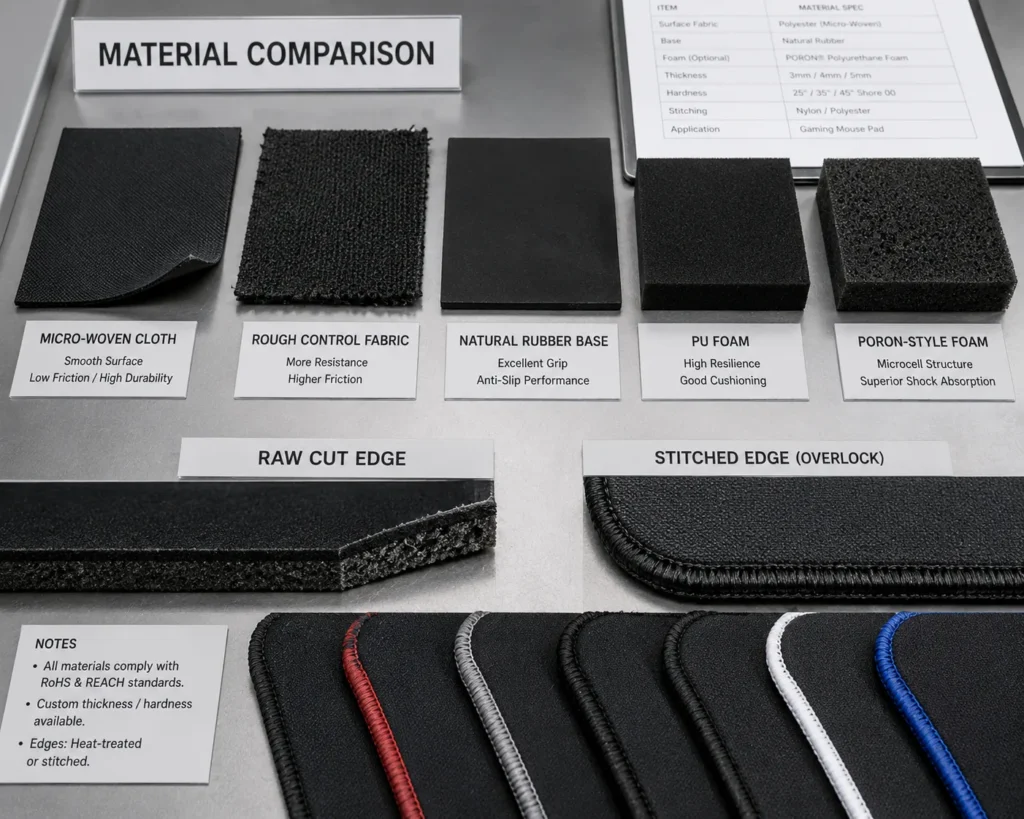
A maioria dos mouse pads macios modernos usa uma camada superior de tecido e uma base de borracha ou espuma.
As marcas de jogos geralmente descrevem a superfície como tecido microtecido, tecido microtexturizado ou tecido com ajuste de desempenho.
Por exemplo, a SteelSeries descreve sua série QcK como usando tecido microtecido e uma base de borracha antiderrapante, sendo que a linha QcK foi relatada pela Dell como tendo mais de 15 milhões de unidades vendidas.
A Razer descreve o Goliathus Chroma como tendo uma superfície de tecido microtexturizado, e sua redação afirma que a base de borracha antiderrapante ajuda a manter o tapete firme no lugar.
Esses exemplos de marcas mostram uma verdade fundamental da fábrica: os melhores mouse pads não são apenas tapetes impressos.
São superfícies projetadas para deslizamento, controle, aderência, conforto e durabilidade.
| Camada | Material comum | Função |
|---|---|---|
| Superfície superior | Tecido de poliéster, microfibra, Lycra, tecido | Rastreamento do mouse e sensação da mão |
| Vínculo intermediário | Adesivo térmico ou camada de laminação | Mantém a superfície e a base unidas |
| Base | Borracha natural, borracha SBR, espuma PU, espuma tipo Poron | Aderência, amortecimento e estabilidade da mesa |
| Borda | Corte bruto, borda costurada, costura sub-superficial | Durabilidade e conforto |
| Embalagem | Saco OPP, capa de papel, caixa colorida, caixa tubular | Proteção e valor de varejo |
Etapa 1: Escolha o tecido de superfície correto
A superfície é a parte que os usuários sentem primeiro.
Ele decide se a almofada é rápida, controlada, áspera, suave, macia ou granulada.
Para um mouse pad padrão de escritório, uma superfície lisa de poliéster geralmente é suficiente.
Para um mouse pad para jogos, a textura da superfície se torna mais importante porque os jogadores se preocupam com a consistência do deslizamento X/Y, a potência de parada e o rastreamento do sensor.
| Tipo de superfície | Sentir | Melhor uso |
|---|---|---|
| Tecido de poliéster liso | Equilibrado, econômico | Almofadas promocionais, almofadas de escritório |
| Tecido microtrançado | Deslizamento mais consistente | Almofadas para jogos e varejo |
| Tecido áspero | Maior controle | Mouse pads de controle de FPS |
| Superfície de lycra | Rápida e suave | Mouse pads com foco na velocidade |
| Couro PU | Visual executivo | Presentes corporativos |
| Superfície dura | Deslizamento muito rápido | Almofadas especiais para jogos |
O tecido também deve funcionar com o processo de impressão.
A sublimação de corante funciona melhor em poliéster porque o corante se une às fibras de poliéster sob calor e pressão.
Etapa 2: Selecione o material de base
A base controla a aderência, o amortecimento e o nivelamento.
A maioria dos mouse pads macios do mercado de massa usa borracha porque ela adere bem à mesa e é econômica.
As almofadas premium podem usar borracha de alta densidade, espuma de PU ou espuma microcelular do tipo Poron para um ressalto mais suave e uma sucção mais forte na mesa.
Rogers descreve os materiais de poliuretano PORON como oferecendo excelente resistência à compressão, e é por isso que as bases do tipo Poron são frequentemente usadas em produtos macios premium em que a recuperação da forma a longo prazo é importante.
| Material de base | Vantagem | Limitação |
|---|---|---|
| Borracha natural | Forte aderência, boa elasticidade | Pode ter odor de borracha |
| Borracha SBR | Econômico e estável | Sensação menos premium |
| Espuma de PU | Macio e leve | Necessita de controle de densidade |
| Espuma do tipo Poron | Ressalto premium e sucção na mesa | Maior custo de material |
| Base de silicone | Alta aderência | Mais caro e menos comum |
Para a produção OEM, a base deve ser selecionada por caso de uso.
Um mouse pad promocional pode usar borracha SBR de 2 a 3 mm.
Uma almofada para jogos premium pode usar borracha de alta densidade de 4 mm ou espuma de PU estilo Poron.
Etapa 3: Preparar a arte
A preparação da arte-final é uma fonte comum de erros de produção.
As fábricas geralmente solicitam arquivos vetoriais ou imagens de alta resolução.
Para impressão em cores, recomenda-se a arte-final de 300 DPI.
Uma área de sangria também é necessária porque o bloco é impresso primeiro e depois cortado.
Lista de verificação da arte de fábrica:
| Item | Padrão recomendado |
|---|---|
| Formato do arquivo | AI, PDF, PSD, PNG, TIFF |
| Resolução | 300 DPI para impressão em cores |
| Modo de cor | Referência CMYK ou Pantone |
| Área de sangramento | 3-5 mm fora do tamanho final |
| Posição do logotipo | Mantenha-se afastado de costuras e bordas cortadas |
| Tamanho do texto | Evite textos minúsculos perto das bordas |
Se o trabalho artístico tiver um fundo branco, a fábrica deverá confirmar se o comprador deseja sangramento total ou uma borda visível.
Pequenos erros de arte ficam muito evidentes após o corte, especialmente em tapetes de mesa grandes.
Etapa 4: Imprima a superfície do mouse pad
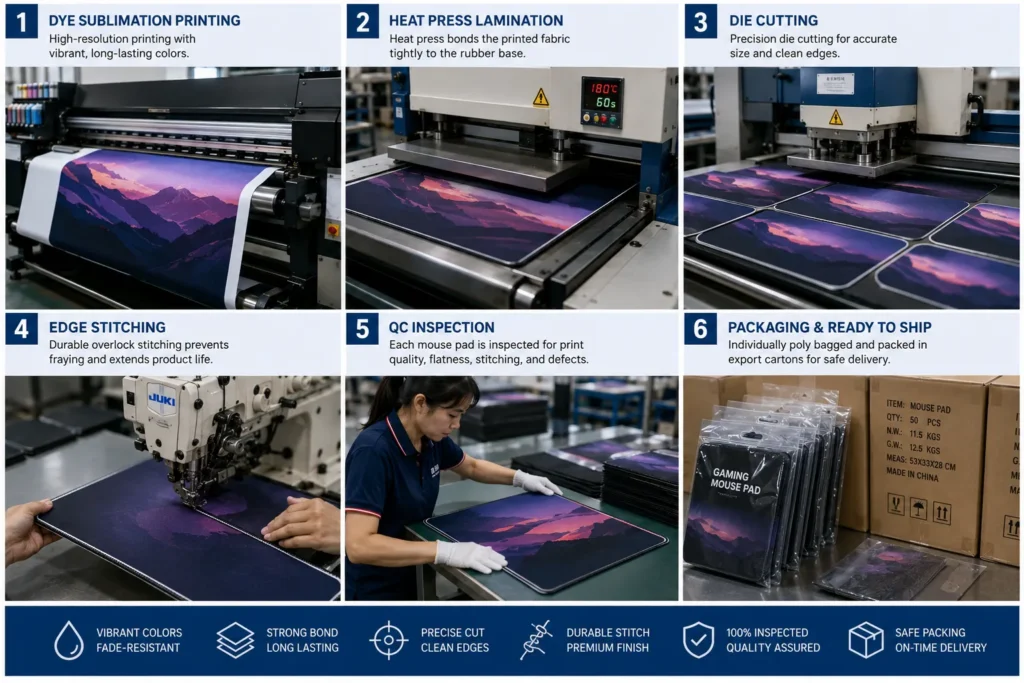
O método de impressão mais comum para mouse pads de tecido é a sublimação de tinta.
Nesse processo, o desenho é impresso em papel de transferência e, em seguida, o calor e a pressão transformam o corante em gás para que ele se ligue às fibras de poliéster.
As fontes de sublimação têxtil geralmente descrevem o processo como o uso de calor em torno de 200°C para unir o corante ao tecido de poliéster.
É por isso que as impressões por sublimação são suaves.
Não há uma camada espessa de tinta sobre o tecido.
| Método de impressão | Melhor para | Comentário da fábrica |
|---|---|---|
| Sublimação de corantes | Almofadas de tecido coloridas | Melhor para trabalhos artísticos vívidos |
| Impressão em tela | Logotipos simples | Custo-benefício para pedidos em massa |
| Impressão UV | Almofadas rígidas, couro PU | Bom para superfícies rígidas |
| Transferência de calor | Pequenas tiragens | Flexível, mas menos durável |
| Impressão têxtil digital | Trabalho artístico detalhado | Útil para designs premium |
Para mouse pads para jogos, a sublimação é preferível porque mantém a textura da superfície mais natural.
Uma camada espessa de tinta na superfície pode alterar o comportamento de deslizamento e rastreamento.
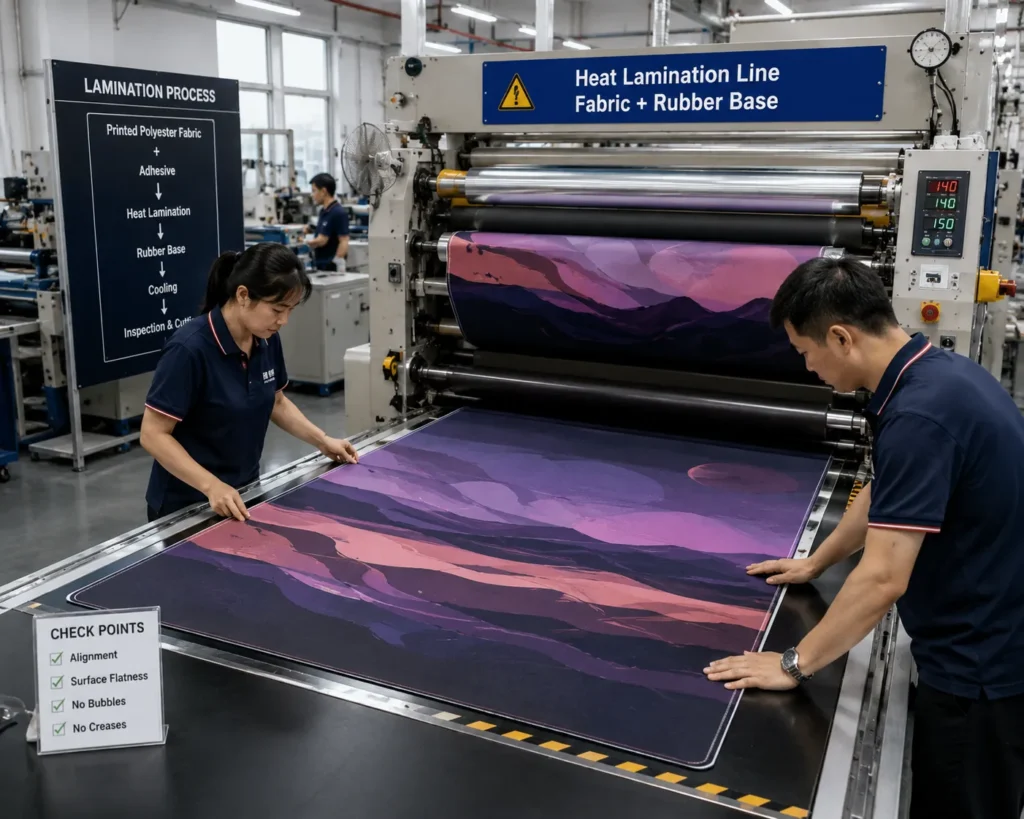
Etapa 5: Laminação da superfície e da base
Após a impressão, o tecido da superfície deve ser colado à base.
Isso geralmente é feito por laminação a quente ou laminação adesiva.
O objetivo é simples: sem bolhas, sem rugas, sem descamação e sem tensão irregular.
Em uma fábrica, o controle de laminação inclui:
| Ponto de controle | Por que é importante |
|---|---|
| Temperatura | Evita danos à colagem fraca ou ao tecido |
| Pressão | Garante uma adesão uniforme |
| Tensão de alimentação | Previne ondas e rugas |
| Quantidade de adesivo | Evita a rigidez ou a delaminação |
| Tempo de resfriamento | Ajuda a manter a folha plana |
Os tapetes de mesa grandes são mais difíceis de laminar do que os mouse pads pequenos.
Uma esteira de 900 × 400 mm expõe mais facilmente as ondas da superfície, a inclinação do tecido e as irregularidades da base.
Etapa 6: Corte o mouse pad no formato desejado
Quando a folha laminada está pronta, a fábrica a corta no formato final.
Os retângulos padrão geralmente são cortados por meio de corte e vinco, corte com régua de aço ou corte CNC.
Formas personalizadas podem exigir uma matriz de corte dedicada.
| Método de corte | Melhor para | Vantagem |
|---|---|---|
| Corte e vinco | Formas padrão | Rápido e consistente |
| Corte CNC | Formas personalizadas | Flexível e preciso |
| Corte a laser | Materiais especiais | Borda limpa para algumas superfícies |
| Corte manual | Amostras | Flexível, mas não ideal para produção em massa |
A tolerância de corte é importante.
Para almofadas padrão, ±1-3 mm é comum, dependendo do material, do tamanho e do processo.
Para os pads de jogos premium, os compradores geralmente esperam uma tolerância mais rígida e bordas mais limpas.
Etapa 7: Adicione a costura da borda
A costura nas bordas protege o mouse pad contra desgaste e delaminação.
Ele também melhora a qualidade percebida.
No entanto, uma costura ruim pode fazer com que uma almofada premium pareça barata.
A costura pode arranhar o braço do usuário ou interferir no movimento do mouse.
| Tipo de borda | Melhor uso | Nota de fábrica |
|---|---|---|
| Corte bruto | Almofadas promocionais de baixo custo | Borda lisa, mas com menor durabilidade |
| Borda com costura padrão | Pads para varejo e jogos | Durável, mas pode parecer levantado |
| Costura de baixo perfil | Almofadas de jogos premium | Melhor conforto para os braços |
| Costura na subsuperfície | Almofadas para esportes eletrônicos de alta qualidade | Requer um controle preciso da costura |
A altura da costura deve ser verificada em relação ao plano da superfície.
Para almofadas de jogos de alta qualidade, o ponto deve ficar próximo ou abaixo da superfície do tecido.
Etapa 8: Controle de qualidade antes da embalagem
O controle de qualidade é onde uma fábrica prova se pode repetir a qualidade.
Uma amostra pode parecer boa.
A produção em massa deve ter a mesma aparência em centenas ou milhares de unidades.
A ISO 9001 é amplamente usada como uma estrutura de gerenciamento de qualidade porque define os requisitos para um sistema de gerenciamento de qualidade em vez de apenas verificar um produto no final.
Na produção de mouse pad, o controle de qualidade deve incluir verificações de aparência, tamanho, superfície, base, borda e embalagem.
| Item de controle de qualidade | Padrão de inspeção |
|---|---|
| Tamanho | Confirme o comprimento, a largura e o raio do canto |
| Espessura | Verifique o centro e os cantos |
| Superfície | Sem manchas, rugas, fantasmas ou faixas de cor |
| Imprimir | Corresponder à amostra aprovada |
| Pega da base | Teste em madeira, vidro, mesa revestida |
| Planicidade | Sem cachos ou ondas |
| Costura na borda | Nenhuma linha solta, ponto pulado ou costura levantada |
| Odor | Sem cheiro forte de produtos químicos |
| Embalagem | Sem esmagamento, poeira ou deformação |
Para almofadas premium, A fábrica deve manter uma amostra dourada.
A produção em massa deve ser comparada com ela antes do envio.
Etapa 9: Embale os mouse pads
A embalagem depende do canal de vendas.
Um mouse pad vendido em uma loja de varejo precisa de uma embalagem diferente de um brinde promocional em massa.
| Tipo de embalagem | Melhor para |
|---|---|
| Saco de OPP | Pedidos em massa de baixo custo |
| Capa de papel | Embalagem ecológica da marca |
| Caixa colorida | Produtos de varejo |
| Caixa de tubos | Tapetes de mesa grandes |
| Caixa Kraft | Embalagem premium minimalista |
| Caixa de presente | Campanhas corporativas |
Os tapetes de mesa grandes geralmente são enrolados para envio.
No entanto, espumas muito macias ou almofadas costuradas na subsuperfície de alta qualidade podem precisar de uma embalagem mais plana para evitar ondulações e deformações nas bordas.
Quanto tempo leva para fazer um mouse pad?
O prazo de entrega depende do tamanho, do material, do método de impressão, da quantidade do pedido e da embalagem.
Para um mouse pad personalizado padrão, a amostragem pode levar de 3 a 7 dias.
A produção em massa geralmente leva de 10 a 25 dias após a aprovação da amostra.
| Tipo de projeto | Tempo de amostragem | Produção a granel |
|---|---|---|
| Mouse pad com logotipo simples | 3-5 dias | 7 a 15 dias |
| Tapete de mesa impresso em cores | 5 a 7 dias | 10 a 20 dias |
| Pad para jogos com bordas costuradas | 7 a 10 dias | 15-25 dias |
| Espuma especial ou formato personalizado | 10-15 dias | 20 a 35 dias |
Os atrasos mais longos geralmente são decorrentes de alterações na arte, fornecimento de materiais, aprovação de embalagens e repetidas revisões de amostras.
O processo real de corte e costura geralmente não é a parte mais lenta.
Detalhamento do custo de fábrica
O preço de um mouse pad depende de mais do que o tamanho.
Os principais fatores de custo são a qualidade do tecido, o material de base, a espessura, o método de impressão, a costura, a embalagem e os requisitos de controle de qualidade.
| Gerador de custos | Impacto no preço |
|---|---|
| Grau do tecido | Médio |
| Base de borracha ou espuma | Alta |
| Espessura | Médio |
| Impressão em cores | Médio |
| Costura na borda | Médio |
| Costura de baixo perfil | Alta |
| Formato superdimensionado | Alta |
| Embalagem personalizada | Médio |
| Teste de certificação | Médio a alto |
| Tolerância a defeitos | Médio |
Um mouse pad barato geralmente é barato por um motivo.
Ele pode usar borracha de menor densidade, laminação mais fraca, tecido mais fino ou inspeção menos rigorosa.
Fórmula de fábrica: Como fazer um mouse pad melhor
Um mouse pad melhor é construído combinando a pilha de materiais com o usuário.
Não existe um único melhor mouse pad para todos.
| Tipo de usuário | Construção recomendada |
|---|---|
| Usuário do Office | Tecido liso + borracha de 3 mm |
| Comprador promocional | Tecido de poliéster + borracha SBR de 2 mm |
| Designer | Superfície lisa + base de borracha estável |
| Jogador de FPS | Tecido de controle + base densa de 4 mm |
| Jogador de velocidade | Lycra ou tecido fino + superfície estável de baixo atrito |
| Marca premium | Tecido personalizado + espuma tipo Poron + costura de baixo perfil |
Para os compradores B2B, a abordagem mais inteligente é definir o caso de uso antes de perguntar o preço.
Uma fábrica só pode fazer uma cotação precisa quando o material e a meta de desempenho estão claros.
Resposta rápida
Um mouse pad é fabricado com a colagem de uma superfície de tecido impresso a uma base de borracha ou espuma, depois é cortado no tamanho certo, com costura nas bordas, se necessário, inspeção de qualidade e embalagem para envio. A maioria dos mouse pads de tecido usa tecido de poliéster porque a sublimação de tinta pode unir permanentemente a cor às fibras de poliéster. As bases comuns incluem borracha natural, borracha SBR, espuma PU e espuma tipo Poron. As espessuras padrão são de 2 mm, 3 mm, 4 mm e 5 mm, enquanto os tamanhos populares variam de mouse pads de escritório de 250 × 200 mm a tapetes de mesa para jogos de 900 × 400 mm.
Lista de verificação da fábrica para compradores
Antes de encomendar um mouse pad personalizado, prepare-se:
| Item | O que confirmar |
|---|---|
| Tamanho | Comprimento final, largura, raio do canto |
| Superfície | Suave, controle, velocidade, áspero, revestido |
| Base | Borracha, SBR, espuma de PU, espuma tipo Poron |
| Espessura | 2 mm, 3 mm, 4 mm, 5 mm |
| Impressão | Sublimação, tela, UV |
| Borda | Corte bruto, costurado, de perfil baixo |
| Embalagem | Saco OPP, manga, caixa, tubo |
| Quantidade | MOQ e mouse pads a granel volume de pedidos |
| CQ | Amostra dourada, tolerância, padrão de cor |
Quanto melhor for a especificação, mais rápido a fábrica poderá fazer a cotação, a amostragem e a produção.
Conclusão
Fazer um mouse pad não é apenas cortar borracha e imprimir um logotipo.
Um processo de fábrica real combina seleção de tecidos, engenharia de base, controle de impressão, laminação, corte de precisão, costura, inspeção e embalagem.
A diferença entre uma almofada de baixo custo e uma almofada premium geralmente está oculta em detalhes que os compradores não conseguem ver imediatamente: tensão do tecido, densidade da espuma, altura da costura, resistência da laminação e planicidade após o transporte.
Para marcas, distribuidores e compradores OEM, entender como um mouse pad é feito ajuda a fazer perguntas melhores.
E perguntas melhores resultam em amostras melhores, menos defeitos e um produto que os usuários realmente gostam.
Que materiais são usados para fazer um mouse pad?
A maioria dos mouse pads macios usa uma camada superior de tecido de poliéster e uma base de borracha ou espuma. As versões premium podem usar tecido microtecido, Lycra, espuma de PU ou espuma do tipo Poron.
Qual é o melhor método de impressão para mouse pads?
A sublimação de tinta geralmente é o melhor método para mouse pads de tecido coloridos porque a tinta se liga às fibras de poliéster e mantém a superfície lisa.
Qual deve ser a espessura de um mouse pad?
As espessuras comuns são 2 mm, 3 mm, 4 mm e 5 mm. As almofadas de escritório geralmente usam 3 mm, enquanto as almofadas premium para jogos geralmente usam 4 mm para maior conforto e estabilidade.
Os mouse pads precisam de bordas costuradas?
As bordas costuradas são recomendadas para mouse pads de jogos e de varejo porque reduzem o desgaste e aumentam a durabilidade. Os pads promocionais de baixo custo podem usar bordas cortadas em bruto.
Quanto tempo leva para fabricar mouse pads personalizados?
A produção de amostras geralmente leva de 3 a 10 dias, enquanto a produção em massa geralmente leva de 10 a 25 dias após a aprovação da amostra, dependendo do material, da quantidade e da embalagem.