O que as pessoas realmente querem saber
Quando alguém pesquisa “como fazer seu próprio mouse pad”, talvez queira um projeto simples de bricolagem.
Mas muitos compradores também estão explorando como mouse pads personalizados são feitas antes de entrar em contato com uma fábrica, lançar uma marca ou fazer um pedido de produtos promocionais.
A intenção real da pesquisa geralmente se divide em quatro grupos:
| Intenção de pesquisa | O que o leitor deseja |
|---|---|
| Usuário DIY | Faça um mouse pad em casa |
| Designer | Imprima a arte em um bloco utilizável |
| Proprietário da marca | Entenda como os pads personalizados são produzidos |
| Comprador | Compare a qualidade do DIY com a produção da fábrica |
| Gerente de sourcing | Preparar especificações para amostras e pedidos em massa |
Um mouse pad caseiro pode ser simples.
Um mouse pad fabricado na fábrica deve controlar a textura da superfície, a aderência da base, a durabilidade da impressão, a planicidade, a tolerância de tamanho e a consistência da embalagem.
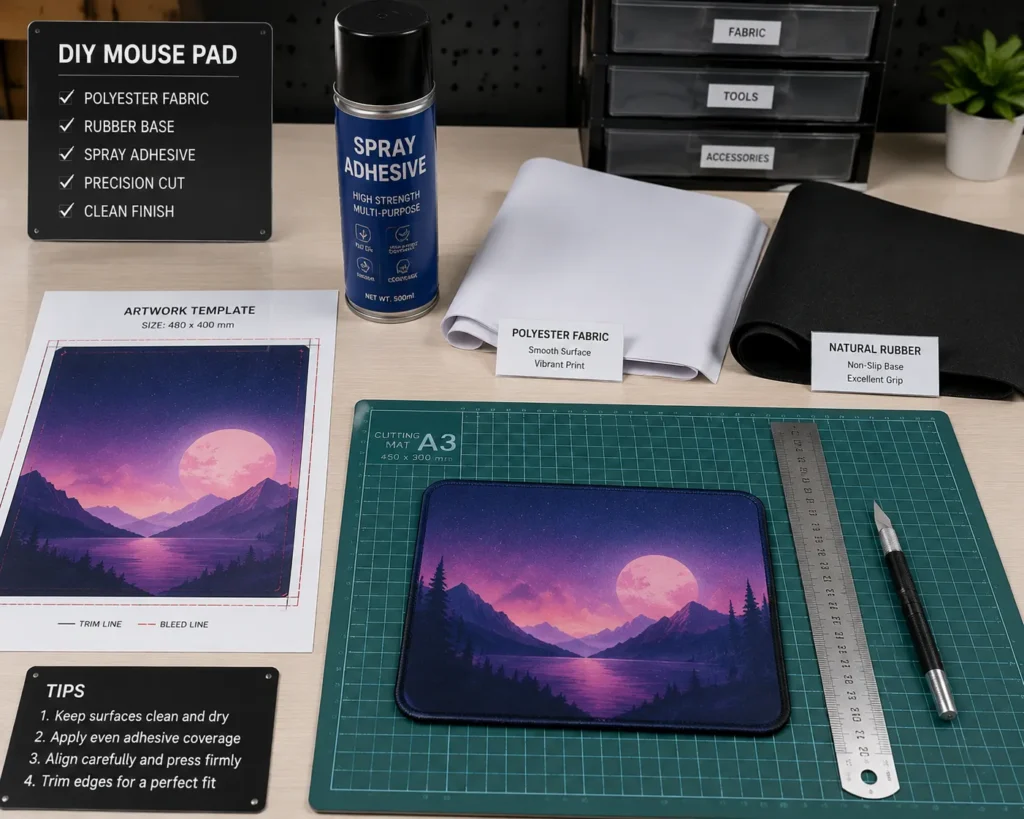
Do que é feito um mouse pad?
A maioria dos mouse pads macios usa uma estrutura em camadas: uma parte superior de tecido, uma camada de cola e uma base de borracha ou espuma.
A SteelSeries descreve seus pads QcK como sendo feitos de tecido microtecido e uma base de borracha antiderrapante, sendo que a linha QcK já vendeu mais de 15 milhões de unidades.
A Razer descreve o Goliathus Chroma usando uma superfície de tecido microtexturizado para velocidade e controle.
Esses exemplos mostram por que a seleção da superfície e da base é importante.
Um bom mouse pad não é apenas um retângulo impresso; ele é uma superfície de rastreamento controlada.
| Camada | Material comum | Finalidade |
|---|---|---|
| Superfície | Tecido de poliéster, microfibra, Lycra, tecido | Controla o deslizamento e o rastreamento |
| Camada de ligação | Adesivo térmico ou filme de laminação | Mantém as camadas unidas |
| Base | Borracha natural, borracha SBR, espuma PU, espuma tipo Poron | Proporciona aderência e amortecimento |
| Borda | Corte bruto ou borda costurada | Evita o desgaste |
| Embalagem | Bolsa, manga, caixa, tubo | Protege a forma e a superfície |
Método DIY vs. método de fábrica
Você pode fazer seu próprio mouse pad em casa com tecido, folha de borracha, adesivo e uma ferramenta de corte.
Mas a produção em fábrica proporciona melhor consistência porque cada etapa é medida.
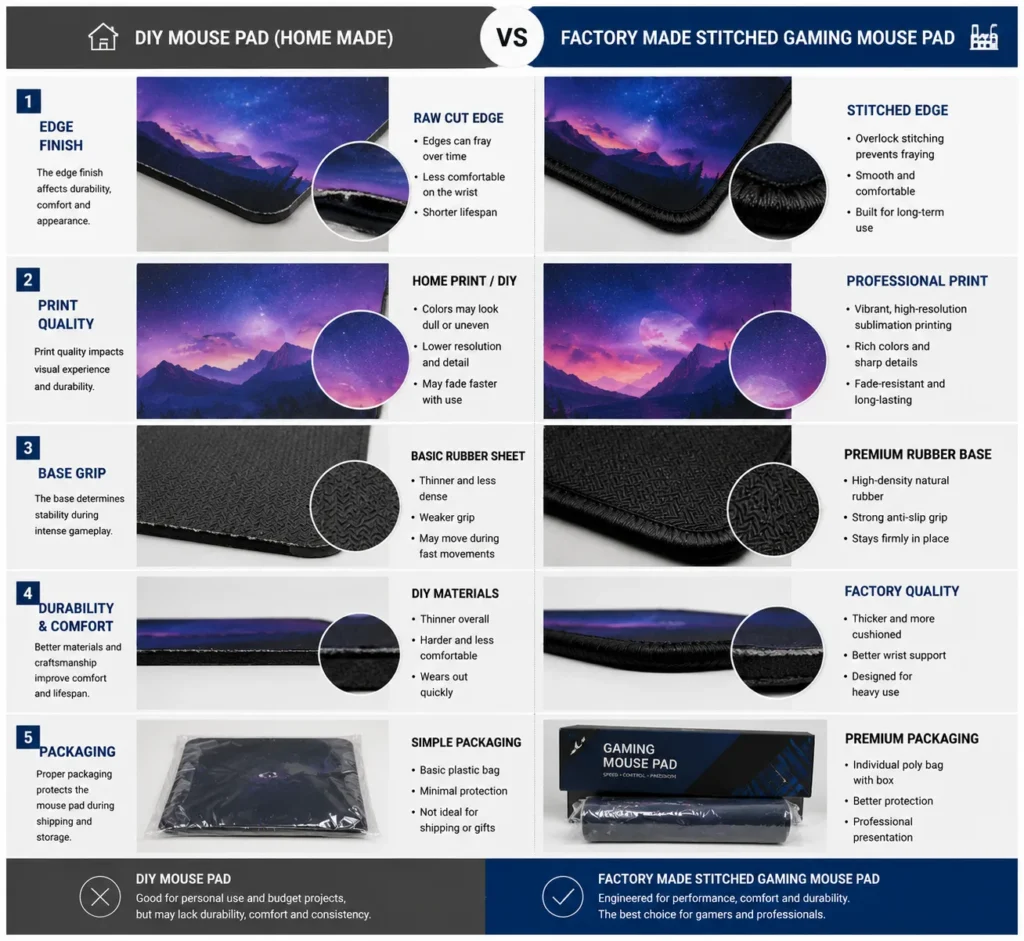
| Item | Mouse Pad DIY | Mouse Pad de fábrica |
|---|---|---|
| Superfície | Tecido ou tecido estampado | Superfície de tecido testada |
| Base | Lençol de borracha, lençol de espuma, cortiça | Borracha, SBR, espuma de PU, espuma tipo Poron |
| Vinculação | Cola em spray ou adesivo de contato | Laminação a quente ou adesivo industrial |
| Corte | Tesoura ou faca de artesanato | Corte e vinco, corte CNC, corte a laser |
| Borda | Normalmente, borda bruta | Costura crua, costurada ou de baixo perfil |
| Qualidade | Depende do trabalho manual | Inspeção de CQ em nível de lote |
O DIY é bom para o aprendizado.
A produção em fábrica é melhor para o varejo, marcas, jogos e pedidos repetidos.
Materiais necessários para fazer seu próprio mouse pad
Para um mouse pad DIY básico, você precisa de uma superfície superior, uma camada de base, adesivo e ferramentas de corte.
Para um profissional mouse pad personalizado, No caso do uso de materiais de construção, a mesma lógica se aplica, mas os materiais devem ser de nível de produção.
| Material | Opção DIY | Opção de fábrica |
|---|---|---|
| Superfície superior | Tecido de poliéster, tecido estampado | Tecido microtecido, tecido de controle, Lycra |
| Base | Lençol de borracha, lençol de espuma | Borracha natural, SBR, espuma de PU |
| Adesivo | Adesivo em spray | Adesivo de laminação térmica |
| Corte | Cortador, régua, tapete | Matriz de aço ou cortador CNC |
| Acabamento da borda | Corte bruto | Borda costurada ou costura de subsuperfície |
Para a impressão, o tecido de poliéster é o preferido, pois a sublimação de tinta se liga melhor às fibras de poliéster sob calor.
É por isso que muitos mouse pads impressos personalizados usam tecido de poliéster em vez de algodão.
Etapa 1: Escolha o tecido da superfície
A superfície é a parte mais importante da experiência do usuário.
Ele afeta a velocidade, o controle, a potência de parada e a sensação da mão.
| Tipo de superfície | Sentir | Melhor para |
|---|---|---|
| Poliéster liso | Equilibrado e econômico | Almofadas para bricolagem e escritório |
| Tecido microtrançado | Rastreamento consistente | Almofadas para jogos e varejo |
| Tecido áspero | Mais atrito e controle | Pads de controle de FPS |
| Lycra | Rápida e suave | Pads para jogos no estilo Speed |
| Couro PU | Aparência de escritório premium | Presentes corporativos |
| Plástico rígido ou vidro | Muito rápido | Almofadas especiais para jogos |
Para uso em bricolagem, o pano de poliéster liso é prático.
Para a produção na fábrica, os compradores devem solicitar amostras de tecido, pois dois tecidos podem ter aparência semelhante, mas desempenho diferente.
Etapa 2: Escolha a base
A base determina se o mouse pad permanecerá plano e se agarrará à mesa.
Uma base fraca deslizará, se curvará ou se deformará.
Rogers descreve PORON As espumas de poliuretano têm excelente resistência à compressão, o que favorece o desempenho de longo prazo em aplicações de amortecimento.
É por isso que a espuma do tipo Poron é frequentemente usada em projetos de mouse pad com base macia premium.
| Material de base | Vantagem | Limitação |
|---|---|---|
| Borracha natural | Forte aderência e elasticidade | Pode ter odor |
| Borracha SBR | Econômico e estável | Sensação menos premium |
| Espuma de PU | Macio e leve | Necessita de controle de densidade |
| Espuma do tipo Poron | Boa recuperação de rebote e compressão | Custo mais alto |
| Cortiça | Fácil de fazer | Menor desempenho em jogos |
Para fazer você mesmo, é mais fácil usar um lençol de borracha.
Para produção em fábrica, borracha natural e a borracha SBR são comuns nas almofadas padrão, enquanto a espuma de PU e a espuma do tipo Poron são usadas nos modelos premium.
Etapa 3: Preparar a arte
Se quiser um mouse pad impresso, prepare a arte antes de cortar.
O trabalho artístico deve ser maior do que o tamanho final, pois o corte remove a borda externa.
Padrões de arte de fábrica:
| Item | Padrão recomendado |
|---|---|
| Resolução | 300 DPI |
| Modo de cor | Referência CMYK ou Pantone |
| Área de sangramento | 3-5 mm |
| Tipo de arquivo | AI, PDF, PSD, TIFF, PNG |
| Posicionamento do texto | Longe da borda e da costura |
| Posição do logotipo | Confirmar com o modelo de tamanho final |
Para uma almofada "faça você mesmo", você pode imprimir o tecido em casa ou usar um serviço de impressão em tecido.
Para produção em fábrica, o arquivo de impressão deve ser verificado antes da amostragem para evitar logotipos borrados ou arte-final cortada.
Etapa 4: Imprimir a superfície
O método de impressão de fábrica mais comum para mouse pads de tecido é a sublimação de tinta.
A sublimação usa o calor para transferir o corante para as fibras de poliéster, o que ajuda a manter a superfície lisa, em vez de adicionar uma camada espessa de tinta por cima.
Isso é importante porque os mouse pads precisam de um deslizamento estável.
Uma camada de tinta em relevo pode alterar o atrito da superfície.
| Método de impressão | Melhor para | Nota de fábrica |
|---|---|---|
| Sublimação de corantes | Almofadas de tecido coloridas | Sensação suave, design vívido |
| Impressão em tela | Logotipos simples | Bom para pedidos grandes e com poucas cores |
| Impressão UV | Almofadas rígidas ou couro PU | Funciona em superfícies rígidas |
| Transferência de calor | Pequenas tiragens | Flexível, mas menos premium |
| Impressão têxtil digital | Desenhos detalhados do tecido | Bom para trabalhos artísticos complexos |
Se estiver fazendo um mouse pad em casa, poderá usar papel de transferência térmica ou tecido estampado.
Se estiver fabricando para venda, a sublimação geralmente é a melhor opção a longo prazo.
Etapa 5: Colar a superfície à base
Um mouse pad falha rapidamente se o tecido se separar da base.
Os projetos de bricolagem geralmente usam adesivo em spray ou cola de contato.
As fábricas usam laminação a quente ou revestimento adesivo controlado para uma ligação mais forte.
| Método de colagem | Caso de uso | Risco |
|---|---|---|
| Adesivo em spray | Amostra DIY | Cola irregular, odor |
| Adesivo de contato | DIY ou lote pequeno | Espessura difícil de controlar |
| Laminação a quente | Produção da fábrica | Necessita da temperatura correta |
| Laminação de filmes | Produção premium | Custo mais alto, mas vínculo mais limpo |
A camada de colagem deve ser fina e uniforme.
O excesso de adesivo pode tornar a superfície rígida.
Uma quantidade insuficiente de adesivo pode causar bolhas ou descascamento.
Etapa 6: Corte o mouse pad
Para fazer você mesmo, use uma régua, um tapete de corte e uma faca afiada para artesanato.
Nas fábricas, o corte é feito com matrizes de régua de aço, cortadores CNC ou cortadores a laser.
| Método de corte | Melhor para | Vantagem |
|---|---|---|
| Faca de artesanato | FAÇA VOCÊ MESMO | Baixo custo |
| Corte e vinco | Formas padrão | Rápido e consistente |
| Corte CNC | Formas personalizadas | Flexível e preciso |
| Corte a laser | Materiais especiais | Borda limpa em superfícies selecionadas |
A tolerância de fábrica para mouse pads macios é geralmente de ±1-3 mm, dependendo do material, da espessura e do tamanho.
Os tapetes de mesa grandes precisam de um controle mais cuidadoso porque os pequenos erros de corte são mais visíveis.
Etapa 7: Finalizar a borda
Uma borda crua é aceitável para almofadas simples de bricolagem.
Para produtos de varejo ou de jogos, as bordas costuradas aumentam a durabilidade.
| Tipo de borda | Melhor uso | Comentário |
|---|---|---|
| Corte bruto | Almofadas promocionais de baixo custo ou do tipo "faça você mesmo | Limpo, mas pode estar desgastado |
| Costura padrão | Almofadas de varejo | Maior durabilidade |
| Costura de baixo perfil | Almofadas para jogos | Mais confortável |
| Costura na subsuperfície | Almofadas premium para esportes eletrônicos | A borda fica mais baixa do que a superfície |
Uma costura ruim pode irritar o braço ou afetar o movimento do mouse.
Para pads de jogos premium, a altura dos pontos deve ser controlada cuidadosamente.
Etapa 8: Teste o mouse pad
Uma fábrica não aprova uma almofada só porque ela tem boa aparência.
O pad deve passar por verificações de desempenho e aparência.
| Item de teste | O que verificar |
|---|---|
| Planicidade | Sem cachos ou ondas |
| Pega | Não desliza sobre a mesa |
| Superfície | Sem rugas, manchas ou inchaços |
| Imprimir | Sem borrões, fantasmas ou faixas de cores |
| Borda | Sem fios soltos ou descascados |
| Espessura | O centro e os cantos são consistentes |
| Odor | Sem cheiro forte de produtos químicos |
| Deslizar | O movimento X/Y parece consistente |
Para fazer o "faça você mesmo", teste o pad com seu mouse normal.
Para a produção na fábrica, mantenha uma amostra dourada aprovada e compare os produtos a granel com ela.
Etapa 9: Embale o mouse pad
A embalagem protege a almofada durante o armazenamento e o transporte.
Isso também afeta a forma como o cliente percebe o produto.
| Tipo de embalagem | Melhor para |
|---|---|
| Saco de OPP | Pedidos em massa de baixo custo |
| Capa de papel | Marca ecológica |
| Caixa colorida | Produtos de varejo |
| Caixa de tubos | Tapetes de mesa grandes |
| Caixa Kraft | Embalagem premium minimalista |
| Caixa de presente | Campanhas corporativas |
Tapetes de mesa grandes são frequentemente enrolados.
As almofadas de espuma macia premium podem precisar de uma embalagem mais plana para reduzir a curvatura ou a deformação das bordas.
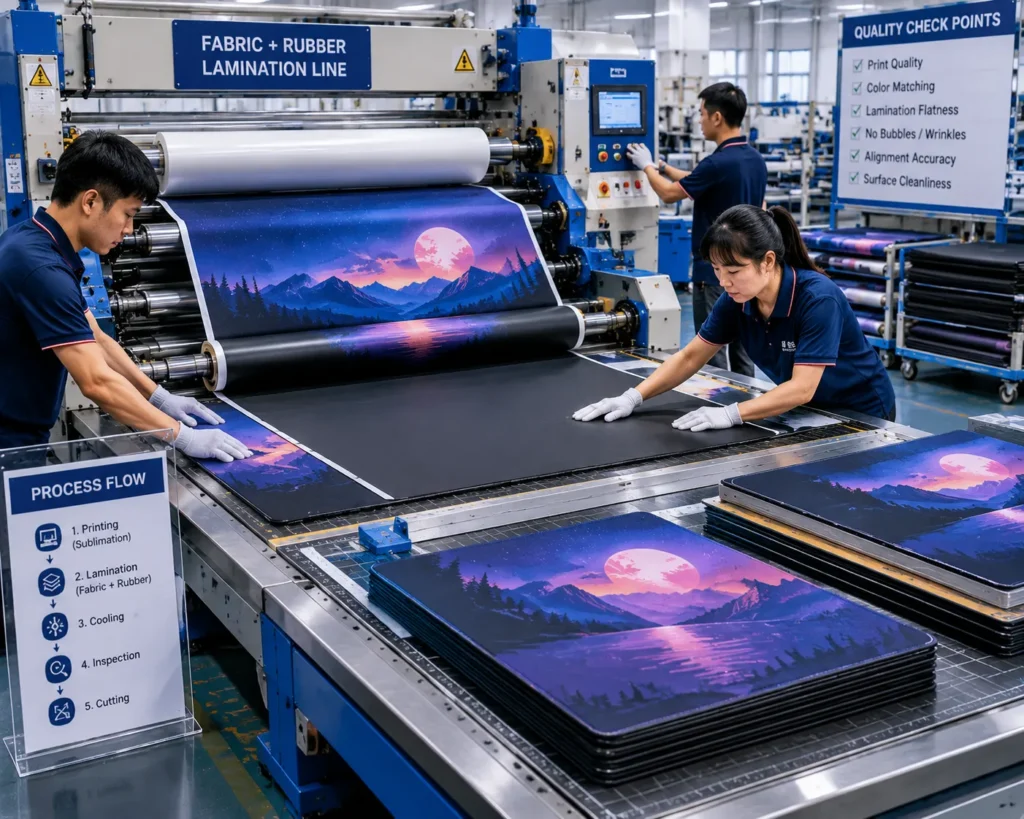
Fluxo de produção da fábrica
Abaixo está um fluxo prático de fábrica para a fabricação de mouse pads personalizados.
| Etapa | Ação de fábrica | Controle de chaves |
|---|---|---|
| 1 | Inspeção de materiais | Tecido, borracha, espuma, tinta |
| 2 | Revisão de arte-final | Tamanho, sangria, cor |
| 3 | Impressão de superfície | Cores e detalhes |
| 4 | Laminação | Colagem e planicidade |
| 5 | Corte | Forma e tolerância |
| 6 | Costura | Altura da borda e tensão da linha |
| 7 | Inspeção de CQ | Superfície, impressão, aderência, odor |
| 8 | Embalagem | Proteção e antiestrias |
| 9 | Embalagem cartonada | Segurança na exportação |
Esse processo é simples de entender, mas difícil de repetir com perfeição.
É por isso que a experiência é importante na fabricação de mousepads.
Composição de custos: Faça você mesmo vs. Fábrica
O custo depende dos materiais, do tamanho, da impressão, do acabamento das bordas e da embalagem.
Uma almofada "faça você mesmo" pode ser barata se você já tiver ferramentas.
A produção em fábrica é mais econômica quando se produz centenas ou milhares de unidades.
| Gerador de custos | Impacto DIY | Impacto na fábrica |
|---|---|---|
| Tecido | Baixo a médio | Médio |
| Material de base | Médio | Alta |
| Impressão | Alto para uma peça | Menor por unidade a granel |
| Corte | Tempo manual | Custo de matriz ou CNC |
| Costura | Difícil em casa | Escalonável na fábrica |
| Embalagem | Simples | Impulsionador do valor da marca |
| CQ | Julgamento pessoal | Inspeção sistemática |
Por um lado, o DIY é prático.
Para uma marca, a produção em fábrica é mais confiável.
Quanto tempo leva?
Um mouse pad DIY pode levar de 1 a 3 horas se os materiais estiverem prontos.
Uma amostra de fábrica geralmente leva de 3 a 10 dias, dependendo da impressão, do material e da costura.
| Tipo de projeto | Tempo de amostragem | Produção a granel |
|---|---|---|
| Mouse pad simples DIY | 1-3 horas | Não se aplica |
| Mouse pad com impressão simples | 3-5 dias | 7 a 15 dias |
| Almofada para jogos costurada | 7 a 10 dias | 15-25 dias |
| Espuma premium ou formato personalizado | 10-15 dias | 20 a 35 dias |
A maioria dos atrasos na fábrica decorre de alterações na arte, fornecimento de materiais e aprovação de embalagens.
O processo de corte em si costuma ser rápido.
Resposta rápida
Para fazer seu próprio mouse pad, escolha uma superfície de tecido, cole-a em uma base de borracha ou espuma, corte-a no tamanho certo e faça o acabamento da borda. Para um mouse pad DIY básico, use tecido de poliéster, folha de borracha, adesivo em spray e uma faca de artesanato. Em uma fábrica, os mouse pads são feitos imprimindo o tecido, laminando-o em borracha ou espuma, cortando-o com matrizes ou máquinas CNC, adicionando bordas costuradas, inspecionando a qualidade e embalando o produto final. As espessuras comuns são de 2 mm, 3 mm, 4 mm e 5 mm, enquanto os tamanhos populares variam de mouse pads de escritório de 250 × 200 mm a tapetes de mesa de 900 × 400 mm.
Conselho final da fábrica
Fazer um mouse pad é fácil.
Fazer o mesmo mouse pad 1.000 vezes com cor, planicidade, qualidade de borda e deslizamento estáveis é o verdadeiro desafio.
Se o objetivo for o uso pessoal, o DIY é suficiente.
Se o objetivo for branding, varejo, jogos ou vendas no atacado, a produção em fábrica oferece melhor repetibilidade e controle de qualidade.
Posso fazer meu próprio mouse pad em casa?
Sim. É possível fazer um mouse pad simples usando tecido de poliéster, folha de borracha ou espuma, adesivo e um cortador afiado. No entanto, os mouse pads de bricolagem geralmente não se comparam à laminação, à costura e à consistência da impressão em nível de fábrica.
Qual é o melhor tecido para fazer um mouse pad?
O tecido de poliéster é uma das melhores opções porque funciona bem com a impressão por sublimação de tinta. Para almofadas de jogos, podem ser usados tecido microtecido, tecido de controle áspero ou Lycra, dependendo do deslizamento desejado.
Que material de base devo usar para um mouse pad DIY?
O lençol de borracha é a base DIY mais fácil de usar, pois adere bem à mesa. Para almofadas premium, as fábricas podem usar borracha natural, borracha SBR, espuma PU ou espuma tipo Poron.
Qual deve ser a espessura de um mouse pad caseiro?
Uma espessura de 3 mm é prática para a maioria dos mouse pads de escritório e de bricolagem. Os mouse pads para jogos geralmente usam 4 mm porque proporcionam mais conforto e estabilidade na mesa.
Posso imprimir meu próprio design em um mouse pad?
Sim. Para fazer você mesmo, você pode usar tecido estampado ou métodos de transferência de calor. Para a produção profissional, a sublimação de tinta é preferível para mouse pads de tecido coloridos porque mantém a superfície lisa.