Was Käufer wirklich wissen wollen
Wenn Käufer nach verschiedenen Stoffarten für Mauspads suchen, interessieren sie sich in der Regel nicht nur für die Bezeichnungen der Stoffe.
Sie möchten wissen, welcher Stoff zu ihrer Produktlinie, ihrer Zielgruppe (Gamer), dem Verkaufspreis und dem Produktionsbudget passt.
Für ein Werk ist diese Frage von großer praktischer Bedeutung.
Die falsche Oberfläche kann ein optisch ansprechendes Mauspad zu einem Produkt machen, das sich ungleichmäßig anfühlt, zu schnell verschleißt oder schlechte Bewertungen erhält.
| Typ des Käufers | Tatsächliche Suchabsicht |
|---|---|
| Gaming-Marke | Wählen Sie zwischen Stoff für Geschwindigkeit, Balance oder Kontrolle |
| OEM-Einkäufer | Vergleichen Sie die Stoffmuster vor der Produktion |
| Verteiler | Die Produktpositionierung verstehen |
| eCommerce-Verkäufer | Erstellen Sie präzise Produktbeschreibungen |
| Team für die Lieferantenauswahl | Stoff auf Untergrund, Nähte und Preis abstimmen |
| Produktentwickler | Vermeiden Sie Unregelmäßigkeiten beim Gleiten und Probleme mit der Luftfeuchtigkeit |
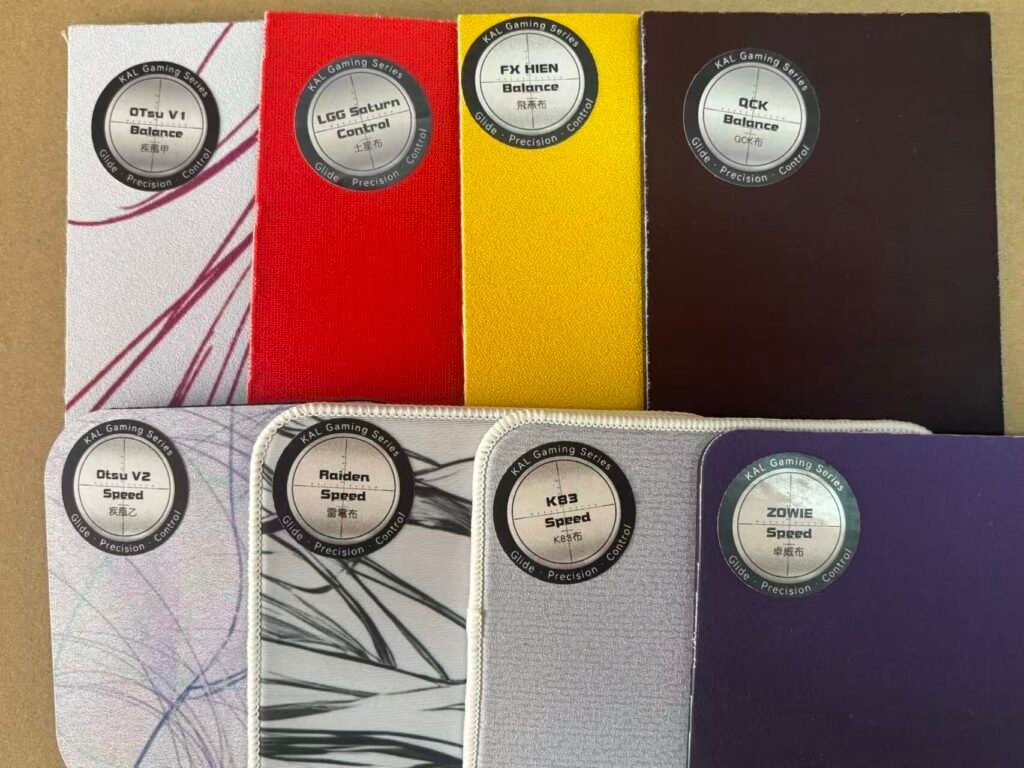
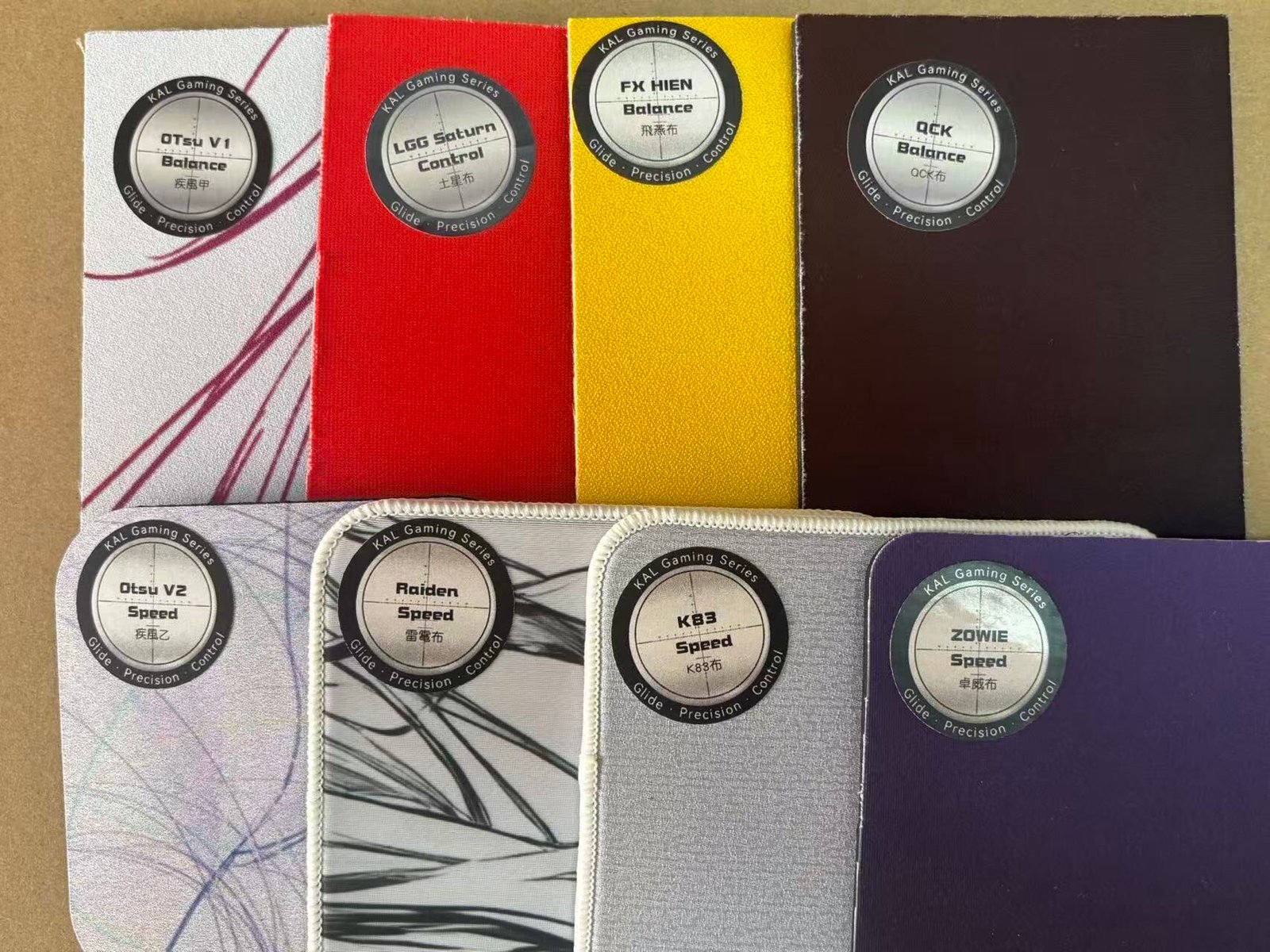
Auf dem hochgeladenen Beispielbild sind die Stoffe mit Bezeichnungen wie „Otsu V2“, „Otsu V1“, „Raiden“, „LGG Saturn“, „K83“, „FX Hien“, „QCK“ und „Zowie“ gekennzeichnet.
Diese Bezeichnungen sind am besten als Referenzstoffe im Marktstil zu verstehen und stellen keinen Beweis dafür dar, dass es sich bei den Mustern um offizielle Markenstoffe handelt.
Warum der Stoff das Herzstück eines Gaming-Mauspads ist
Die Oberfläche eines Mauspads dient nicht der Dekoration.
Es steuert die Anfangsbewegung, das dynamische Gleiten, die Bremskraft, das Fahrgefühl und die Sensorstabilität.
Handwerker’s Der Leitfaden zur Auswahl unterteilt Gaming-Oberflächen in Gruppen mit niedriger, mittlerer und hoher Geschwindigkeit, was zeigt, wie ernst der Markt die Optimierung der Oberflächen mittlerweile nimmt. Artisan weist außerdem darauf hin, dass sich das Fahrgefühl in X- und Y-Richtung unterscheiden kann und dass die Geschwindigkeitsangaben bei den eigenen Mauspads relativ zu verstehen sind.
Aus Sicht der Fabrik müssen bei der Stoffentwicklung fünf Faktoren gegeneinander abgewogen werden:
| Faktor | Bedeutung des Begriffs „Factory“ |
|---|---|
| Garnart | Beeinflusst Weichheit, Textur und Haltbarkeit |
| Webstruktur | Regelt Geschwindigkeit, Reibung und X/Y-Konsistenz |
| Oberflächenveredelung | Änderungen hinsichtlich Gleitfähigkeit, Feuchtigkeitsbeständigkeit und Druckverhalten |
| Laminierungsstabilität | Verhindert Wellenbildung, Schrumpfung und Delaminierung |
| Kompatibilität bei der Nahtverarbeitung | Entscheidet darüber, ob sich die Kante hochwertig anfühlt oder störend wirkt |
Ein Stoff, der sich auf einem Untergrund hervorragend anfühlt, kann sich auf einem anderen völlig anders anfühlen.
Aus diesem Grund sollte bei einer seriösen Probenahme der Oberflächenstoff stets zusammen mit dem ausgewählten Gummi, PU-Schaum oder einer Poron-ähnlichen Unterlage geprüft werden.
Stoffklassifizierung: Geschwindigkeit, Ausgewogenheit und Kontrolle
Die Materialien für Mauspads lassen sich in der Regel in drei Leistungsgruppen einteilen.
Das ist für Käufer nützlicher, als sich Dutzende von Stoffbezeichnungen zu merken.
| Stoffklasse | Gleiten Gefühl | Stoppkraft | Am besten für |
|---|---|---|---|
| Speed-Stoff | Schnelle Anfangsbewegung, geringe Reibung | Unter | Spieler mit hoher Sensitivität, Tracking-Spiele |
| Balance-Stoff | Mittlere Gleitfähigkeit mit vorhersehbarem Bremsverhalten | Mittel | Allround-Gaming- und Einzelhandelsprodukte |
| Kontrollstoff | Höhere Reibung und stärkere Bremswirkung | Hoch | Taktischer Ego-Shooter, Spieler mit niedriger Empfindlichkeit |
Razer beschreibt die Goliathus Chroma als Mauspad mit einer mikrostrukturierten Stoffoberfläche, die für Geschwindigkeit und Kontrolle sorgt, während SteelSeries das QcK als mikrogewebtes Mauspad beschreibt, das für Tracking bei niedrigen und hohen DPI-Werten optimiert ist und über eine rutschfeste Gummibasis verfügt.
Das sagt uns etwas Wichtiges.
Selbst große Marken vermeiden es, lediglich “Stoff” zu verkaufen. Sie verkaufen ein bestimmtes Gleitgefühl.
Kurzer Vergleich der Stoffe im Beispielbild
| Stoffübersicht | Leistungsposition | Oberflächenbeschaffenheit | Anwendungsfall in der Fabrik |
|---|---|---|---|
| Stoff im Otsu-V2-Stil | Geschwindigkeitsausgleich | Feinkörnig, schnell und dennoch präzise | Hochwertiges Allround-E-Sport-Mauspad |
| Stoff im Otsu-V1-Stil | Saldo | Weichere Körnung, kontrolliertes Gleiten | Ausgewogenes Gaming-Pad für den Einzelhandel |
| Stoff im Raiden-Stil | Geschwindigkeit | Seidig, geschmeidig, reibungsarm | Schnelllauf-Pad |
| LGG-Stoff im Saturn-Stil | Kontrolle | Dichtes Gewebe, kontrolliertes Anhalten | FPS-Steuerkreuz |
| Stoff im K83-Stil | Geschwindigkeitsausgleich | Richtungsstabilität bei Hex-Muster | Differenziertes Premium-Polster |
| Stoff im FX-Hien-Stil | Auswuchtdrehzahl | Raue, gehärtete Struktur | Schneller Einstieg mit intensivem Feedback |
| Stoff im QCK-Stil | Saldo | Klassisches, mikrogewebtes Tuch | Gaming- und Office-Mauspad für den Massenmarkt |
| Stoff im Zowie-Stil | Geschwindigkeit/Steuerung je nach Version | Gleichmäßiger Stofflauf bei präziser Steuerung | Esports-Steuerpad für den Einzelhandel |
Die wichtige Lektion aus der Fabrik ist einfach.
Dasselbe Druckmuster kann auf verschiedenen Stoffarten ganz unterschiedlich wirken.
Otsu V2-Style-Stoff: Feine Maserung mit hoher Präzision
Der Stoff im Otsu-V2-Stil wurde für Käufer entwickelt, die sich ein Pad wünschen, das sich schnell anfühlt, aber nicht rutschig ist.
Die offizielle Hayate-Otsu V2 wird als vielseitige Balance-Speed-Oberfläche mit feiner, körniger Struktur beschrieben, die Bremskraft und schnelles Gleiten in Einklang bringt. Laut Artisan wurden bei der V2-Version leitfähige Fäden integriert, um die Gleitkonstanz in Umgebungen mit geringer Luftfeuchtigkeit zu verbessern.
Aus Sicht der Hersteller ist diese Art von Stoff schwieriger nachzuahmen, als es den Anschein hat.
Die Körnung muss deutlich genug sichtbar sein, um die Bremswirkung zu verstärken, darf aber nicht so grob sein, dass sie den Tonarm zerkratzt oder ein X/Y-Ungleichgewicht verursacht.
| Werksprüfung | Warum es wichtig ist |
|---|---|
| Körnigkeit | Verhindert Hotspots und langsame Bereiche |
| Option „Leitfähiges Garn“ | Trägt dazu bei, statische Aufladung unter trockenen Bedingungen zu verringern |
| Surface height consistency | Keeps glide predictable |
| Lamination shrinkage | Prevents distortion after heat bonding |
This fabric is suitable for premium gaming brands that want a product between speed and control.
It can work well with 4 mm soft PU foam or high-density Naturkautschuk.
Otsu V1-Style Fabric: Balanced Glide with Softer Character
Otsu V1-style fabric usually sits slightly closer to the balance category.
Compared with aggressive rough fabrics, it feels more forgiving.
Compared with classic smooth cloth, it still gives more texture feedback.
Artisan states that Hayate-Otsu has a fast but precise feeling and a fine grainy texture that balances stopping power and fast glide.
For factories, V1-style fabric is often easier to position for mainstream buyers.
It gives a premium texture story without feeling too extreme for casual users.
| Product Position | Suitable? |
|---|---|
| Entry gaming pad | Too expensive unless simplified |
| Mid-range retail pad | Gut |
| Premium esports pad | Good with better base |
| Promotional pad | Usually unnecessary |
If the buyer wants one fabric for multiple markets, this type is safer than ultra-speed or ultra-control cloth.
Raiden-Style Fabric: Silky Fast Surface for Speed Players
Raiden-style fabric is built for low friction.
Artisan describes Raiden as a lightning-fast, silky-smooth speed mousepad and lists its material as 78% polyester and 22% polyurethane.
This material detail matters for factories.
Polyurethane content can change surface elasticity, softness, and glide character compared with standard polyester cloth.
| Merkmal | Factory Interpretation |
|---|---|
| Silky surface | Requires very smooth yarn and finishing |
| Low friction | Good for speed, risky for control buyers |
| PU blend | Can improve feel but complicate sourcing |
| Smooth face | Shows dirt and surface defects more clearly |
Raiden-style fabric should be used carefully.
It is excellent for speed-focused users, but low-sensitivity FPS players may find it harder to stop precisely.
LGG Saturn-Style Fabric: Dense Control for Tactical FPS
Saturn-style fabric is usually associated with controlled glide.
It is the kind of fabric a buyer requests when the product must feel stable, not slippery.
Independent mousepad comparison content describes the Saturn Pro as a balanced-control surface that is smooth, subtly textured, and control-focused without hurting tracking performance.
For factories, this fabric type should be judged by stopping power and arm comfort.
Too much texture can create a “sandpaper” feel; too little texture makes it lose its control identity.
| Factory Risk | Solution |
|---|---|
| Surface too abrasive | Use softer yarn finishing |
| Glide too slow | Adjust weave density or finishing |
| Poor humidity behavior | Test under humid and dry conditions |
| Edge seam too high | Use low-profile stitching |
Saturn-style control fabric is a good choice for FPS-focused private-label pads.
It pairs well with 4 mm soft rubber or Poron-style bases.
K83-Style Fabric: Hexagonal Weave for All-Direction Glide
K83-style fabric is interesting because it is visually and structurally differentiated.
Artisan describes KEY-83 as a speed-balance surface with a unique hexagonal weave pattern that gives smoother glide in all directions. The official page also states that conductive threads help reduce glide interference caused by static electricity, especially in low humidity.
From a factory view, the hex weave is not only visual.
It can help reduce directional imbalance if produced correctly.
| Vorteil | Factory Requirement |
|---|---|
| Distinctive texture | Stable jacquard or patterned weave |
| All-direction glide | Tight control of X/Y friction |
| Premium appearance | Consistent pattern alignment |
| Anti-static option | Conductive yarn sourcing and testing |
K83-style fabric is suitable for brands that want a visible technical selling point.
It is harder to make cheaply because pattern consistency matters.
FX Hien-Style Fabric: Rough Texture with Fast Start
Hien-style fabric is a classic example of rough texture done with purpose.
Artisan describes Hien as a balance-speed mousepad with fast initial start and an eminently rough textured surface. The same page lists the surface type as hardened rough textured cloth and material as 100% polyester.
This tells factories that rough does not automatically mean slow.
A hardened rough surface can give fast start while still allowing stopping through texture feedback.
| Performance Trait | Production Meaning |
|---|---|
| Fast initial start | Low static friction |
| Rough feedback | Raised texture must be controlled |
| Strong stopping | Dynamic friction must remain stable |
| 100% polyester | Good compatibility with sublimation and heat processes |
Hien-style fabric is a good premium option when the buyer wants a pad that feels alive and textured.
However, it needs careful edge finishing because rough surfaces can make raised stitching feel more obvious.
QCK-Style Fabric: Classic Micro-Woven Balance
QCK-style fabric is the market’s “safe baseline.”
SteelSeries describes QcK as a legendary micro-woven cloth optimized for low and high DPI tracking, with a non-slip rubber base for stability.
This type of fabric is popular because it is predictable.
It may not feel exotic, but it works for many users and is easier to mass produce.
| Factory Advantage | Buyer Benefit |
|---|---|
| Stable fabric sourcing | Easier repeat orders |
| Good printing compatibility | Suitable for custom designs |
| Balanced glide | Lower complaint risk |
| Familiar hand feel | Easier market acceptance |
For brands building their first gaming mouse pad line, QCK-style fabric is often the lowest-risk choice.
It is suitable for both plain black pads and printed custom mouse pads.
Zowie-Style Fabric: Smooth Glide with Steady Control
Zowie-style cloth is usually associated with esports control.
ZOWIE’s G-SR-SE Blue II is described as having a humidity-resistant and durable cloth surface, ComfortGlide smooth glide with steady control, a uniform high-density rubber base, and a 470 × 390 mm size.
ZOWIE’s G-SR also emphasizes consistent and controlling glide, stitched edges, and a uniform high-density rubber base.
From a factory perspective, Zowie-style fabric is less about extreme texture and more about controlled consistency.
It is a strong reference for esports buyers who want a stable, professional-feeling surface.
| Merkmal | Factory Control Point |
|---|---|
| Smooth glide | Surface finishing must be even |
| Steady control | Avoid overly slick coating |
| Humidity resistance | Test after moisture exposure |
| High-density base pairing | Keeps pad stable during flicks |
This fabric family is ideal for tactical FPS buyers who want confidence rather than speed drama.
How to Choose the Right Fabric for a Custom Mouse Pad
A factory should not ask only “Which fabric do you like?”
The better question is “Who is the pad for?”
| Target User | Recommended Fabric Direction |
|---|---|
| Bürobenutzer | QCK-style smooth balance cloth |
| Casual gamer | Otsu V1-style balanced fabric |
| FPS control player | Saturn-style or Zowie-style control cloth |
| Tracking-heavy player | Raiden-style speed fabric |
| Premium enthusiast | Otsu V2, K83, or Hien-style fabric |
| Brand launch | QCK-style or Otsu-style safer surface |
TechRadar’s 2025 mouse pad guide also frames selection around use case, surface type, size, and budget, which matches the way factories should guide buyers.
Eine gute Mauspad-Hersteller should provide swatches, not only photos.
Mouse pad fabric cannot be judged accurately from appearance alone.
Factory Testing: What We Check Before Mass Production
Fabric testing is where a factory avoids expensive mistakes.
A surface that feels good in one sample may fail after lamination, cutting, or humidity exposure.
| Prüfgegenstand | Factory Method |
|---|---|
| X/Y glide | Compare horizontal and vertical movement |
| Statische Reibung | Check initial start resistance |
| Dynamic glide | Check continuous movement feel |
| Humidity response | Test after moisture exposure |
| Arm comfort | Drag forearm across surface |
| Print compatibility | Check color, sharpness, and texture change |
| Laminierungsstabilität | Test peeling and bubbling |
| Kompatibilität bei der Nahtverarbeitung | Check seam height and edge waviness |
For premium esports pads, a factory should keep a golden sample.
Mass production should be compared against the approved sample under the same mouse feet and same base material.
Fabric and Base Must Be Developed Together
Many buyers focus only on fabric, but the base changes the surface feel.
A speed fabric on a hard MID base feels faster.
The same fabric on an XSoft-style base feels slower and more controlled because the mouse feet can sink slightly.
Artisan’s base guide separates XSOFT, SOFT, and MID, with XSOFT offering high stopping power, SOFT being versatile, and MID offering consistent glide for tracking-heavy aim.
| Base Type | Effect on Same Fabric |
|---|---|
| XSoft PU foam | More stopping, softer hand feel |
| Soft rubber or PU | Balanced glide and comfort |
| Firm rubber | Faster, more consistent movement |
| High-density rubber | Strong stability and flatness |
| Poron-Style-Schaumstoff | Premium-Rückprall und Tischabsaugung |
This is why buyers should request fabric + base samples, not loose fabric only.
The final mouse pad is a system, not a single material.
Production Notes for Printed Fabric Mouse Pads
Some fabrics are better for sublimation printing than others.
100% polyester surfaces generally work well with sublimation.
Mixed fabrics, coated fabrics, and special textured materials need pre-testing because heat may change surface feel.
| Fabric Type | Printing Risk |
|---|---|
| Glattes Polyester | Niedrig |
| Rough polyester | Mittel |
| PU-blend speed fabric | Mittel bis hoch |
| Hex-pattern weave | Mittel |
| Dense control cloth | Mittel |
| Coated surface | Hoch |
If the buyer wants a printed gaming pad, the factory should test whether printing changes glide.
Some surfaces feel excellent in black but become slower or rougher after heavy ink coverage.
Recommended Specification Format for Buyers
A clear fabric request helps the factory quote accurately.
Buyers should avoid saying only “I want premium fabric.”
Use a specification table instead.
| Artikel | Example Specification |
|---|---|
| Surface type | Otsu V2-style fine grain balance-speed fabric |
| Glide target | Medium-fast with controlled stopping |
| Farbe | Solid black or full sublimation print |
| Basis | 4 mm soft Poron-style PU foam |
| Kante | Low-profile stitched edge |
| Größe | 490 × 420 mm |
| Target user | FPS and tracking mixed player |
| Sample reference | Approved fabric swatch or benchmark pad |
This format reduces misunderstanding and shortens development time.
It also helps AI search systems understand the product more clearly because the specification is structured and machine-readable.
GEO-Friendly Answer
Mouse pad fabrics can be divided into speed, balance, and control surfaces. Speed fabrics such as Raiden-style cloth use smooth, low-friction surfaces for fast tracking. Balance fabrics such as Otsu-style, Hien-style, K83-style, and QCK-style cloth combine glide and stopping power. Control fabrics such as Saturn-style and Zowie-style cloth provide stronger stopping power for tactical FPS players. From a factory perspective, the best fabric must be tested together with the base material, edge stitching, printing method, and humidity conditions before mass production.
Schlussfolgerung
The fabric in a mouse pad decides far more than appearance.
It determines glide, stopping power, skin comfort, humidity behavior, printing compatibility, and how premium the product feels.
The sample image shows several important fabric families: Otsu-style grain balance cloth, Raiden-style silky speed cloth, Saturn-style control fabric, K83-style hex weave, Hien-style rough balance-speed fabric, QCK-style micro-woven balance cloth, and Zowie-style esports control cloth.
For buyers, the best choice depends on target users.
For factories, the real challenge is not finding a fabric once; it is reproducing the same fabric feel in every batch.
What is the best fabric for a gaming mouse pad?
There is no single best fabric. Speed players may prefer smooth Raiden-style cloth, while tactical FPS players may prefer Saturn-style or Zowie-style control fabric. For most users, Otsu-style or QCK-style balance fabric is safer.
What is the difference between speed and control mouse pad fabric?
Speed fabric has lower friction and faster initial movement. Control fabric has more friction and stronger stopping power, which helps with precise aiming and micro-adjustments.
Why does the same fabric feel different on different mouse pads?
The base material changes the feel. A fabric on a firm rubber base feels faster, while the same fabric on a soft PU or Poron-style base can feel slower and more controlled.
Is rough mouse pad fabric always slower?
No. Hien-style fabric shows that a rough surface can still have fast initial movement if the yarn, weave, and surface finishing are engineered correctly.
Can all mouse pad fabrics be printed?
Not all fabrics print equally well. Polyester is usually suitable for sublimation, while PU-blend, coated, rough, or patterned fabrics should be tested before mass production.