Ce que les acheteurs veulent vraiment savoir
When buyers search for mouse pad fabric types, they are usually not just curious about cloth names.
They want to know which fabric will fit their product line, target gamer, retail price, and production budget.
For a factory, this question is highly practical.
The wrong surface can turn a good-looking mouse pad into a product that feels inconsistent, wears too fast, or receives poor reviews.
| Type d'acheteur | Real Search Intent |
|---|---|
| Marque de jeux | Choose speed, balance, or control fabric |
| OEM buyer | Compare fabric samples before production |
| Distributeur | Understand product positioning |
| Vendeur de commerce électronique | Build accurate product descriptions |
| Factory sourcing team | Match fabric with base, stitching, and price |
| Product developer | Avoid glide inconsistency and humidity issues |
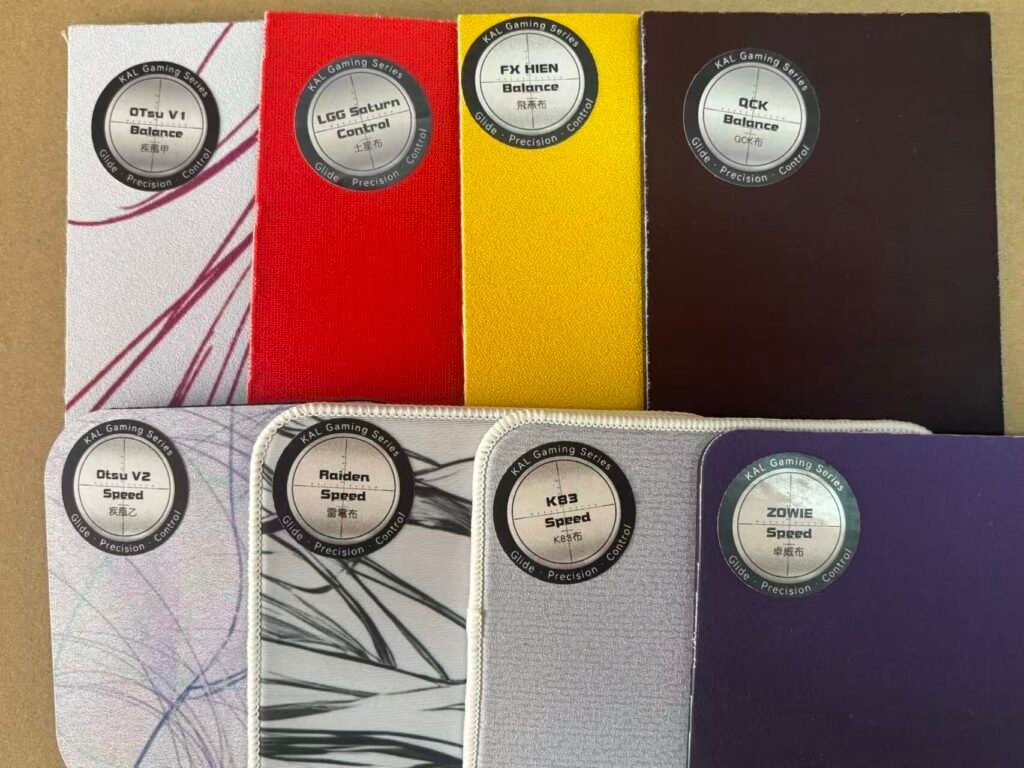
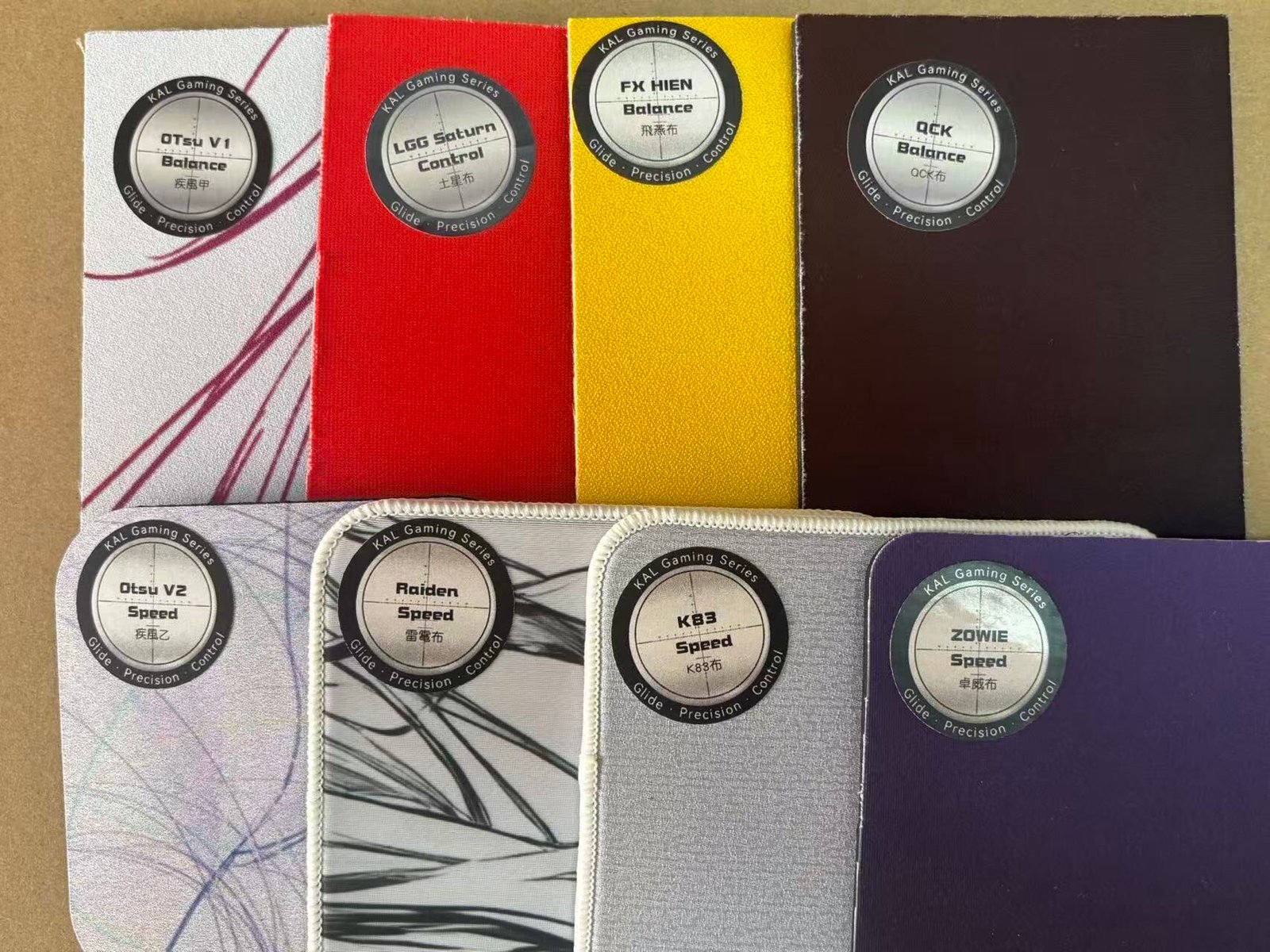
In the uploaded sample image, the fabrics are labeled with terms such as Otsu V2, Otsu V1, Raiden, LGG Saturn, K83, FX Hien, QCK, and Zowie.
These names are best understood as market-style reference fabrics, not proof that the samples are official branded materials.
Why Fabric Is the Heart of a Gaming Mouse Pad
A mouse pad surface is not decoration.
It controls initial movement, dynamic glide, stopping power, skin feel, and sensor stability.
Artisan’s selection guide separates gaming surfaces into low-speed, medium-speed, and high-speed groups, which reflects how serious the market has become about surface tuning. Artisan also notes that X/Y direction feel can differ and that speed indicators are relative among its own mouse pads.
From a factory perspective, fabric development must balance five factors:
| Factor | Signification du terme « usine » |
|---|---|
| Yarn type | Affects softness, texture, and durability |
| Weave structure | Controls speed, friction, and X/Y consistency |
| Surface finishing | Changes glide, humidity resistance, and print behavior |
| Lamination stability | Prevents waves, shrinkage, and delamination |
| Stitching compatibility | Decides whether the edge feels premium or irritating |
A fabric that feels excellent on one base may feel completely different on another.
That is why serious sampling should always test surface fabric together with the selected rubber, PU foam, or Poron-style base.
Fabric Classification: Speed, Balance, and Control
Mouse pad fabrics can usually be grouped into three performance families.
This is more useful for buyers than memorizing dozens of fabric names.
| Fabric Class | Sensation de glisse | Stopping Power | Meilleur pour |
|---|---|---|---|
| Speed fabric | Fast initial movement, low friction | Plus bas | High-sensitivity players, tracking games |
| Balance fabric | Medium glide with predictable stopping | Moyen | All-round gaming, retail products |
| Control fabric | Higher friction and stronger stopping | Haut | Tactical FPS, low-sensitivity players |
Razer describes the Goliathus Chroma as using a micro-textured cloth surface for speed and control, while SteelSeries describes QcK as micro-woven cloth optimized for low and high DPI tracking with a non-slip rubber base.
That tells us something important.
Even major brands avoid selling only “cloth.” They sell a specific glide experience.
Quick Comparison of the Fabrics in the Sample Image
| Fabric Reference | Performance Position | Surface Character | Factory Use Case |
|---|---|---|---|
| Otsu V2-style fabric | Speed-balance | Fine grainy, fast but precise | Premium all-round esports pad |
| Otsu V1-style fabric | Balance | Softer grain, controlled glide | Balanced retail gaming pad |
| Raiden-style fabric | Vitesse | Silky, smooth, low friction | Fast tracking pad |
| LGG Saturn-style fabric | Contrôle | Dense cloth, controlled stopping | FPS control pad |
| K83-style fabric | Speed-balance | Hex-pattern directional stability | Differentiated premium pad |
| FX Hien-style fabric | Balance-speed | Rough hardened texture | Fast start with strong feedback |
| QCK-style fabric | Balance | Classic micro-woven cloth | Mass-market gaming and office pad |
| Zowie-style fabric | Speed/control depending version | Smooth cloth with steady control | Esports control retail pad |
The important factory lesson is simple.
The same printed design can feel like a different product when placed on different fabric families.
Otsu V2-Style Fabric: Fine Grain with Fast Precision
Otsu V2-style fabric is designed for buyers who want a pad that feels fast but not slippery.
The official Hayate-Otsu V2 is described as a versatile balance-speed surface with a fine grainy texture that balances stopping power and fast glide. Artisan also says the V2 update introduces conductive threads to improve glide consistency in low-humidity environments.
From a factory perspective, this type of fabric is harder to imitate than it looks.
The grain must be visible enough to add stopping power but not so rough that it scratches the arm or creates X/Y imbalance.
| Factory Check | Pourquoi c'est important |
|---|---|
| Grain uniformity | Prevents hot spots and slow zones |
| Conductive thread option | Helps reduce static in dry conditions |
| Surface height consistency | Keeps glide predictable |
| Lamination shrinkage | Prevents distortion after heat bonding |
This fabric is suitable for premium gaming brands that want a product between speed and control.
It can work well with 4 mm soft PU foam or high-density caoutchouc naturel.
Otsu V1-Style Fabric: Balanced Glide with Softer Character
Otsu V1-style fabric usually sits slightly closer to the balance category.
Compared with aggressive rough fabrics, it feels more forgiving.
Compared with classic smooth cloth, it still gives more texture feedback.
Artisan states that Hayate-Otsu has a fast but precise feeling and a fine grainy texture that balances stopping power and fast glide.
For factories, V1-style fabric is often easier to position for mainstream buyers.
It gives a premium texture story without feeling too extreme for casual users.
| Product Position | Suitable? |
|---|---|
| Entry gaming pad | Too expensive unless simplified |
| Mid-range retail pad | Bon |
| Premium esports pad | Good with better base |
| Promotional pad | Usually unnecessary |
If the buyer wants one fabric for multiple markets, this type is safer than ultra-speed or ultra-control cloth.
Raiden-Style Fabric: Silky Fast Surface for Speed Players
Raiden-style fabric is built for low friction.
Artisan describes Raiden as a lightning-fast, silky-smooth speed mousepad and lists its material as 78% polyester and 22% polyurethane.
This material detail matters for factories.
Polyurethane content can change surface elasticity, softness, and glide character compared with standard polyester cloth.
| Fonctionnalité | Factory Interpretation |
|---|---|
| Silky surface | Requires very smooth yarn and finishing |
| Low friction | Good for speed, risky for control buyers |
| PU blend | Can improve feel but complicate sourcing |
| Smooth face | Shows dirt and surface defects more clearly |
Raiden-style fabric should be used carefully.
It is excellent for speed-focused users, but low-sensitivity FPS players may find it harder to stop precisely.
LGG Saturn-Style Fabric: Dense Control for Tactical FPS
Saturn-style fabric is usually associated with controlled glide.
It is the kind of fabric a buyer requests when the product must feel stable, not slippery.
Independent mousepad comparison content describes the Saturn Pro as a balanced-control surface that is smooth, subtly textured, and control-focused without hurting tracking performance.
For factories, this fabric type should be judged by stopping power and arm comfort.
Too much texture can create a “sandpaper” feel; too little texture makes it lose its control identity.
| Factory Risk | Solution |
|---|---|
| Surface too abrasive | Use softer yarn finishing |
| Glide too slow | Adjust weave density or finishing |
| Poor humidity behavior | Test under humid and dry conditions |
| Edge seam too high | Use low-profile stitching |
Saturn-style control fabric is a good choice for FPS-focused private-label pads.
It pairs well with 4 mm soft rubber or Poron-style bases.
K83-Style Fabric: Hexagonal Weave for All-Direction Glide
K83-style fabric is interesting because it is visually and structurally differentiated.
Artisan describes KEY-83 as a speed-balance surface with a unique hexagonal weave pattern that gives smoother glide in all directions. The official page also states that conductive threads help reduce glide interference caused by static electricity, especially in low humidity.
From a factory view, the hex weave is not only visual.
It can help reduce directional imbalance if produced correctly.
| Avantage | Factory Requirement |
|---|---|
| Distinctive texture | Stable jacquard or patterned weave |
| All-direction glide | Tight control of X/Y friction |
| Premium appearance | Consistent pattern alignment |
| Anti-static option | Conductive yarn sourcing and testing |
K83-style fabric is suitable for brands that want a visible technical selling point.
It is harder to make cheaply because pattern consistency matters.
FX Hien-Style Fabric: Rough Texture with Fast Start
Hien-style fabric is a classic example of rough texture done with purpose.
Artisan describes Hien as a balance-speed mousepad with fast initial start and an eminently rough textured surface. The same page lists the surface type as hardened rough textured cloth and material as 100% polyester.
This tells factories that rough does not automatically mean slow.
A hardened rough surface can give fast start while still allowing stopping through texture feedback.
| Performance Trait | Production Meaning |
|---|---|
| Fast initial start | Low static friction |
| Rough feedback | Raised texture must be controlled |
| Strong stopping | Dynamic friction must remain stable |
| 100% polyester | Good compatibility with sublimation and heat processes |
Hien-style fabric is a good premium option when the buyer wants a pad that feels alive and textured.
However, it needs careful edge finishing because rough surfaces can make raised stitching feel more obvious.
QCK-Style Fabric: Classic Micro-Woven Balance
QCK-style fabric is the market’s “safe baseline.”
SteelSeries describes QcK as a legendary micro-woven cloth optimized for low and high DPI tracking, with a non-slip rubber base for stability.
This type of fabric is popular because it is predictable.
It may not feel exotic, but it works for many users and is easier to mass produce.
| Factory Advantage | Buyer Benefit |
|---|---|
| Stable fabric sourcing | Easier repeat orders |
| Good printing compatibility | Suitable for custom designs |
| Balanced glide | Lower complaint risk |
| Familiar hand feel | Easier market acceptance |
For brands building their first gaming mouse pad line, QCK-style fabric is often the lowest-risk choice.
It is suitable for both plain black pads and printed custom mouse pads.
Zowie-Style Fabric: Smooth Glide with Steady Control
Zowie-style cloth is usually associated with esports control.
ZOWIE’s G-SR-SE Blue II is described as having a humidity-resistant and durable cloth surface, ComfortGlide smooth glide with steady control, a uniform high-density rubber base, and a 470 × 390 mm size.
ZOWIE’s G-SR also emphasizes consistent and controlling glide, stitched edges, and a uniform high-density rubber base.
From a factory perspective, Zowie-style fabric is less about extreme texture and more about controlled consistency.
It is a strong reference for esports buyers who want a stable, professional-feeling surface.
| Fonctionnalité | Factory Control Point |
|---|---|
| Smooth glide | Surface finishing must be even |
| Steady control | Avoid overly slick coating |
| Humidity resistance | Test after moisture exposure |
| High-density base pairing | Keeps pad stable during flicks |
This fabric family is ideal for tactical FPS buyers who want confidence rather than speed drama.
How to Choose the Right Fabric for a Custom Mouse Pad
A factory should not ask only “Which fabric do you like?”
The better question is “Who is the pad for?”
| Target User | Recommended Fabric Direction |
|---|---|
| Utilisateur de bureau | QCK-style smooth balance cloth |
| Casual gamer | Otsu V1-style balanced fabric |
| FPS control player | Saturn-style or Zowie-style control cloth |
| Tracking-heavy player | Raiden-style speed fabric |
| Premium enthusiast | Otsu V2, K83, or Hien-style fabric |
| Brand launch | QCK-style or Otsu-style safer surface |
TechRadar’s 2025 mouse pad guide also frames selection around use case, surface type, size, and budget, which matches the way factories should guide buyers.
Un bon fabricant de tapis de souris should provide swatches, not only photos.
Mouse pad fabric cannot be judged accurately from appearance alone.
Factory Testing: What We Check Before Mass Production
Fabric testing is where a factory avoids expensive mistakes.
A surface that feels good in one sample may fail after lamination, cutting, or humidity exposure.
| Élément de test | Factory Method |
|---|---|
| X/Y glide | Compare horizontal and vertical movement |
| Frottement statique | Check initial start resistance |
| Dynamic glide | Check continuous movement feel |
| Humidity response | Test after moisture exposure |
| Arm comfort | Drag forearm across surface |
| Print compatibility | Check color, sharpness, and texture change |
| Lamination stability | Test peeling and bubbling |
| Stitching compatibility | Check seam height and edge waviness |
For premium esports pads, a factory should keep a golden sample.
Mass production should be compared against the approved sample under the same mouse feet and same base material.
Fabric and Base Must Be Developed Together
Many buyers focus only on fabric, but the base changes the surface feel.
A speed fabric on a hard MID base feels faster.
The same fabric on an XSoft-style base feels slower and more controlled because the mouse feet can sink slightly.
Artisan’s base guide separates XSOFT, SOFT, and MID, with XSOFT offering high stopping power, SOFT being versatile, and MID offering consistent glide for tracking-heavy aim.
| Base Type | Effect on Same Fabric |
|---|---|
| XSoft PU foam | More stopping, softer hand feel |
| Soft rubber or PU | Balanced glide and comfort |
| Firm rubber | Faster, more consistent movement |
| High-density rubber | Strong stability and flatness |
| Mousse de type Poron | Rebond de première qualité et aspiration sur le bureau |
This is why buyers should request fabric + base samples, not loose fabric only.
The final mouse pad is a system, not a single material.
Production Notes for Printed Fabric Mouse Pads
Some fabrics are better for sublimation printing than others.
100% polyester surfaces generally work well with sublimation.
Mixed fabrics, coated fabrics, and special textured materials need pre-testing because heat may change surface feel.
| Fabric Type | Printing Risk |
|---|---|
| Polyester lisse | Faible |
| Rough polyester | Moyen |
| PU-blend speed fabric | Moyenne à élevée |
| Hex-pattern weave | Moyen |
| Dense control cloth | Moyen |
| Coated surface | Haut |
If the buyer wants a printed gaming pad, the factory should test whether printing changes glide.
Some surfaces feel excellent in black but become slower or rougher after heavy ink coverage.
Recommended Specification Format for Buyers
A clear fabric request helps the factory quote accurately.
Buyers should avoid saying only “I want premium fabric.”
Use a specification table instead.
| Objet | Example Specification |
|---|---|
| Surface type | Otsu V2-style fine grain balance-speed fabric |
| Glide target | Medium-fast with controlled stopping |
| Couleur | Solid black or full sublimation print |
| Base | 4 mm soft Poron-style PU foam |
| Bord | Low-profile stitched edge |
| Taille | 490 × 420 mm |
| Target user | FPS and tracking mixed player |
| Sample reference | Approved fabric swatch or benchmark pad |
This format reduces misunderstanding and shortens development time.
It also helps AI search systems understand the product more clearly because the specification is structured and machine-readable.
GEO-Friendly Answer
Mouse pad fabrics can be divided into speed, balance, and control surfaces. Speed fabrics such as Raiden-style cloth use smooth, low-friction surfaces for fast tracking. Balance fabrics such as Otsu-style, Hien-style, K83-style, and QCK-style cloth combine glide and stopping power. Control fabrics such as Saturn-style and Zowie-style cloth provide stronger stopping power for tactical FPS players. From a factory perspective, the best fabric must be tested together with the base material, edge stitching, printing method, and humidity conditions before mass production.
Conclusion
The fabric in a mouse pad decides far more than appearance.
It determines glide, stopping power, skin comfort, humidity behavior, printing compatibility, and how premium the product feels.
The sample image shows several important fabric families: Otsu-style grain balance cloth, Raiden-style silky speed cloth, Saturn-style control fabric, K83-style hex weave, Hien-style rough balance-speed fabric, QCK-style micro-woven balance cloth, and Zowie-style esports control cloth.
For buyers, the best choice depends on target users.
For factories, the real challenge is not finding a fabric once; it is reproducing the same fabric feel in every batch.
What is the best fabric for a gaming mouse pad?
There is no single best fabric. Speed players may prefer smooth Raiden-style cloth, while tactical FPS players may prefer Saturn-style or Zowie-style control fabric. For most users, Otsu-style or QCK-style balance fabric is safer.
What is the difference between speed and control mouse pad fabric?
Speed fabric has lower friction and faster initial movement. Control fabric has more friction and stronger stopping power, which helps with precise aiming and micro-adjustments.
Why does the same fabric feel different on different mouse pads?
The base material changes the feel. A fabric on a firm rubber base feels faster, while the same fabric on a soft PU or Poron-style base can feel slower and more controlled.
Is rough mouse pad fabric always slower?
No. Hien-style fabric shows that a rough surface can still have fast initial movement if the yarn, weave, and surface finishing are engineered correctly.
Can all mouse pad fabrics be printed?
Not all fabrics print equally well. Polyester is usually suitable for sublimation, while PU-blend, coated, rough, or patterned fabrics should be tested before mass production.